4H CCI Strategy 1.3Still working on fixing the code 100%. Will update with a new version soon. This one's fine tuned for gold (tp and sl size, and contract size for a 100k account) Cheers, Ivan Labrie Time at Mode FXPine Script® Strategievon IvanLabrie77171
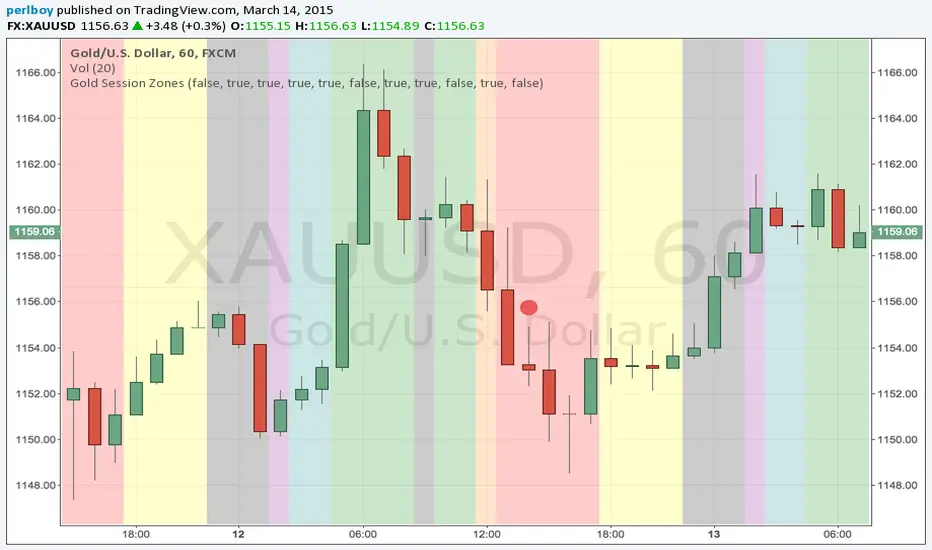
Gold Market Session Breakdown [perlboy] - UTC OnlyVery simple script to apply colours to Gold market areas. Includes Globex daily stop and morning London fix. Doesn't know how to handle weekends (yet). Pine Script® Indikatorvon perlboy167
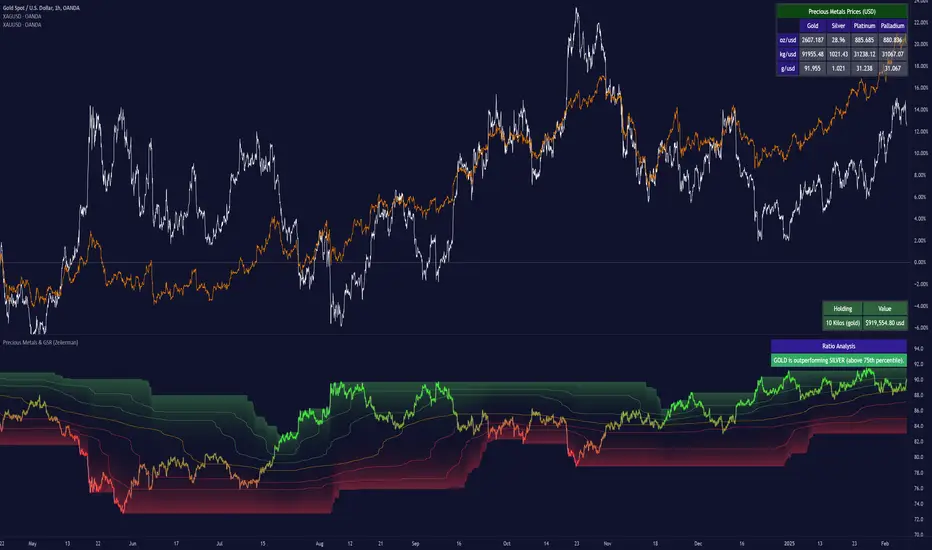
Precious Metals & GSR (Zeiierman)█ Overview The Precious Metals & GSR (Zeiierman) is designed to provide traders and investors with a comprehensive view of the Gold-Silver Ratio (GSR) and other precious metal relationships. This tool helps evaluate the relative strength between different metals by analyzing their price ratios over historical periods, using quantile-based analysis and trend interpretation tables to highlight key insights. The Gold-Silver Ratio (GSR) is a widely utilized metric in precious metals trading, representing the number of silver ounces required to purchase one ounce of gold. Historically, this ratio has fluctuated, providing traders with insights into the relative value of these two metals. By analyzing the GSR, traders can identify potential trading opportunities based on historical patterns and market dynamics. By integrating customizable percentile bands, gradient coloring for performance visualization, and dynamic ratio analysis, this indicator assists in understanding how one metal is performing relative to another, making it useful for trend tracking, risk management, and portfolio allocation. █ How It Works The Precious Metals & GSR Indicator operates by fetching the latest prices of the selected precious metals in the user's chosen currency. It then calculates the ratio between two selected metals (Metal 1 and Metal 2) and analyzes this ratio over a specified period. By computing quantile bands and high/low bands, the indicator provides insights into the historical performance and current standing of the ratio. ⚪ Ratio Calculation The core of this indicator is the metal ratio, calculated by dividing the price of Metal 1 by Metal 2. A rising ratio means Metal 1 is outperforming Metal 2. A falling ratio means Metal 2 is outperforming Metal 1. The indicator automatically retrieves live market prices of Gold, Silver, Platinum, and Palladium to compute the ratio. ⚪ Quantile Ratio Bands The indicator calculates the highest (max) and lowest (min) ratio levels over a user-defined period. It also plots quantile bands at the 10th, 25th, 50th (median), 75th, and 90th percentiles, providing deeper statistical insights into how extreme or average the current ratio is. The median (Q50) acts as a reference level, showing whether the ratio is above or below its historical midpoint. ⚪ Interpretation Table The Ratio Interpretation Table provides a text-based summary of the ratio’s strength. It detects whether Metal 1 is at a historical high, low, or within common ranges. This helps traders and investors make informed decisions on whether the ratio is overextended, mean-reverting, or trending. ⚪ Precious Metals Table Displays live market prices for Gold, Silver, Platinum, and Palladium. Prices are shown in different units (oz, kg, grams, and troy ounces) based on user preferences. A color-coded system highlights price changes, making it easier to track market movements. ⚪ Physical Holding Calculator Users can enter their precious metal holdings to estimate their current value. The system adjusts calculations based on weight, purity (24K, 22K, etc.), and unit of measurement. The holding value is displayed in the selected currency (USD, EUR, GBP, etc.). █ How to Use ⚪ Trend Identification If the ratio is increasing, Metal 1 is gaining strength relative to Metal 2 → Possible Long Position on Metal 1 / Short on Metal 2 If the ratio is decreasing, Metal 2 is gaining strength relative to Metal 1 → Possible Short Position on Metal 1 / Long on Metal 2 ⚪ Mean Reversion Strategy When the ratio reaches the 90th percentile, Metal 1 is historically overextended (expensive) compared to Metal 2. Traders may look to sell Metal 1 and buy Metal 2, expecting the ratio to decline back toward its historical average. Example (Gold/Silver Ratio): If the GSR is above the 90th percentile, gold is very expensive relative to silver, suggesting a potential buying opportunity in silver and/or a selling opportunity in gold. When the ratio reaches the 10th percentile, Metal 1 is historically undervalued (cheap) compared to Metal 2. Traders may look to buy Metal 1 and sell Metal 2, expecting the ratio to rise back toward its historical average. Example (Gold/Silver Ratio): If the GSR is below the 10th percentile, gold is very cheap relative to silver, suggesting a potential buying opportunity in gold and/or a selling opportunity in silver. ⚪ Common Strategy Based on GSR Insights A common approach involves monitoring the ratio for extreme values based on historical data. When the ratio reaches historically high levels, it suggests that gold is expensive relative to silver, potentially indicating a buying opportunity for silver and/or a selling opportunity for gold. Conversely, when the ratio is at historically low levels, silver is expensive relative to gold, suggesting a potential buying opportunity for gold and/or selling opportunity for silver. This mean-reversion strategy relies on the tendency of the GSR to return to its historical average over time. ⚪ Hedging & Portfolio Diversification If Gold is strongly outperforming Silver, investors may shift allocations to balance risk. If Silver is rapidly gaining on Gold, it may indicate increased industrial demand or speculative interest. ⚪ Inflation & Economic Cycles A rising Gold-Silver ratio often correlates with economic downturns and increased risk aversion. A falling Gold-Silver ratio may signal stronger economic growth and higher inflation expectations. █ Settings Precious Metals Table Select which metals to display (Gold, Silver, Platinum, Palladium) Choose measurement units (oz, kg, grams, troy ounces) Ratio Analysis Select Metal 1 & Metal 2 for ratio calculation Set historical length for quantile calculations Interpretation Table Enable automated insights based on ratio levels Physical Holdings Calculator Enter metal weight, purity, and unit Select calculation currency ----------------- Disclaimer The content provided in my scripts, indicators, ideas, algorithms, and systems is for educational and informational purposes only. It does not constitute financial advice, investment recommendations, or a solicitation to buy or sell any financial instruments. I will not accept liability for any loss or damage, including without limitation any loss of profit, which may arise directly or indirectly from the use of or reliance on such information. All investments involve risk, and the past performance of a security, industry, sector, market, financial product, trading strategy, backtest, or individual's trading does not guarantee future results or returns. Investors are fully responsible for any investment decisions they make. Such decisions should be based solely on an evaluation of their financial circumstances, investment objectives, risk tolerance, and liquidity needs. Pine Script® Indikatorvon Zeiierman55487
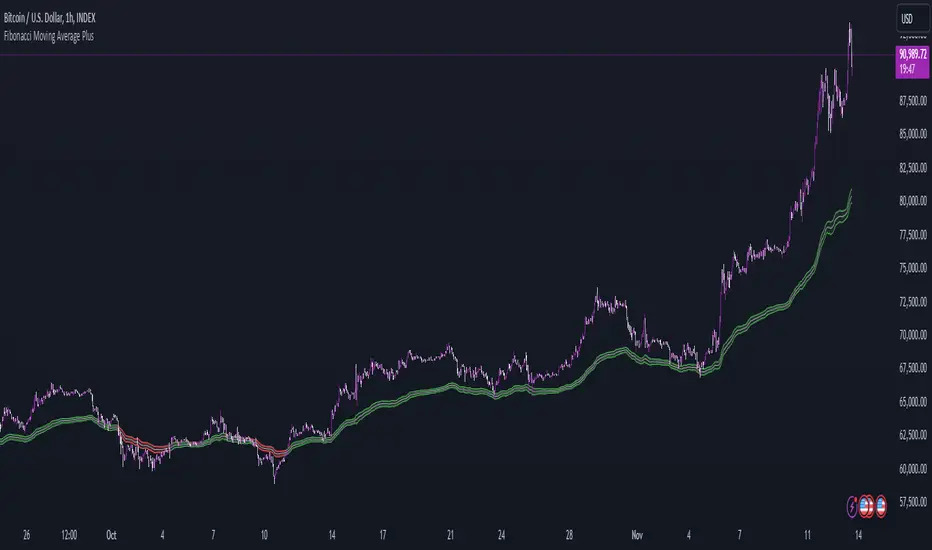
Fibonacci Moving Average PlusFibonacci Moving Average Plus is a sophisticated technical indicator that employs the first 15 numbers of the Fibonacci sequence to create dynamic moving average channels. This indicator aims to capture both immediate and long-term price movements by calculating Exponential Moving Averages (EMAs) based on these Fibonacci values. By using Fibonacci-based moving averages for both high and low price points, the indicator generates a visual channel that reflects the ebb and flow of market trends, acting as potential zones of support and resistance. Additionally, the indicator provides midline, retracement, and extension levels rooted in Fibonacci ratios, which are frequently observed as key levels for reversals or trend continuation. Ideology Behind Using Fibonacci Sequence-Based Moving Averages The Fibonacci sequence, known for its mathematical harmony and prevalence in natural patterns, is widely utilized in technical analysis to identify potential turning points in markets. In this indicator, the first 15 Fibonacci numbers (5, 8, 13, 21, etc.) are used as the lookback periods for EMAs to capture different layers of market sentiment. These moving averages represent timeframes that are theoretically in alignment with the natural rhythms of market cycles, where key levels—often coinciding with Fibonacci numbers—can act as magnetic points for price. The Fibonacci high and low channels aim to encapsulate price action, giving traders a sense of whether the market is trending, consolidating, or experiencing reversal pressure. These levels, grounded in both mathematics and market psychology, help traders spot areas where price might face resistance or find support. Key Features Fibonacci Moving Average High and Low: This indicator calculates the high and low EMAs based on Fibonacci sequence numbers (e.g., 5, 8, 13, etc.) for enhanced trend analysis. Golden Pocket Retracement (GPR) and Extension (GPE) Bands: Displays common Fibonacci retracement and extension levels (0.618, 0.65 for retracement, and 1.618, 1.65 for extension). Midline: Plots the average of the Fibonacci high and low to act as an additional reference level. Stop-Loss Levels: Provides suggested stop-loss levels based on Fibonacci levels for both long and short positions. Basic User Guide Adjust Input Settings: Input Timeframe: Set a specific timeframe for the Fibonacci moving average calculation, separate from the chart's primary timeframe. Show Fibonacci MA High/Low: Toggle the visibility of the high and low Fibonacci moving averages. Show Mid Line: Display a midline for added trend reference. Show Golden Pocket Bands: Choose to display retracement or extension bands for potential support or resistance zones. Show Stop-Loss Levels: Enable to visualize potential stop-loss levels for both long and short trades. Interpretation: Fibonacci MA High and Low: Use these lines to gauge the general trend. When the price is above both, it may indicate an uptrend; below both, a downtrend. Golden Pocket Retracement: This zone (between 0.618 and 0.65) is often a key level for potential reversals or support/resistance. Golden Pocket Extension: The 1.618 and 1.65 levels can indicate potential profit-taking or trend exhaustion points. Stop-Loss Levels: The calculated stop-loss levels (long SL below and short SL above) can aid in risk management. Customization: You can customize the appearance and visibility of each component through the input settings to fit your specific strategy and visual preferences. This indicator should be used alongside other technical analysis tools to provide a more comprehensive trading approach. This Indicator would not exist without the original contributions and blessing from Sofien KaabarPine Script® Indikatorvon SwizzleShizzle22531
Geopbytech Risk Based Lots Calculator📊 Geopbytech – Risk Based Lots Calculator Built by Juan C. Delgado A lightweight and fast position size calculator designed to help traders determine optimal lot size directly from the TradingView chart. No more switching to external websites during live execution. Simply input: Account Size (USD) Risk Ratio % Stop-Loss distance (pips or points) The tool instantly calculates the correct lot size based on proper risk management. 🔹 How It Works The calculator determines: Risk ($) = Account Size × Risk % Lot Size = Risk ($) ÷ (Stop-Loss Units × $ Value per Unit per 1 Lot) Everything updates instantly as you change values. 🔹 Example Account Size Risk % Stop Loss Result $10,000 1% 20 pips 0.50 lots $5,000 1% 15 pips 0.33 lots $8,000 2% 30 pips 0.53 lots 🔹 Default Configuration (Forex – EURUSD) By default, the script is optimized for standard Forex pairs like EURUSD. You only need to: Enter Account Size Enter Risk % Enter Stop-Loss in pips The script automatically calculates pip value using standard 100,000 contract size. 🔹 Trading Gold (XAUUSD) If you are trading Gold: Enable: ✔ Override $ per unit (non-FX) Then adjust: • Override $ per 1 unit per 1 lot (or use Custom Unit Size if needed depending on broker specification) Because gold brokers may use different contract sizes. 🔹 Trading Indices For indices (NAS100, US30, SPX, etc.): You can: • Leave override OFF (if TradingView provides correct point value) OR • Enable Override and manually define $ value per point per lot Depends on your broker's contract specification. 🔹 Trading Cross Pairs (GBPJPY, EURJPY, etc.) For Forex crosses: Leave override OFF. If calculation warning appears: Adjust "Custom Unit Size" to match correct pip structure. Example: GBPJPY may require adjusting unit size depending on feed. 🔹 Inputs Explained Account Size (USD) Your total trading account balance. Risk Ratio % Percentage of account you are willing to lose per trade. (Example: 1% = disciplined risk management) Stop-Loss (pips / points) Distance from entry to stop loss. This must match what you use in the TradingView position tool. Custom Unit Size (price) Advanced setting. Used when your symbol does not follow standard pip or tick logic. You define how much price movement equals 1 unit. FX Contract Size Default: 100,000 (standard lot in Forex). Only change if your broker uses non-standard contract sizes. 🎨 UI Customization You can customize: • Theme (Dark / Light / Midnight) • Dashboard Position • Transparency • Text Size • Warning visibility ⚠️ Important Notes This tool calculates position size based on TradingView symbol specifications. Broker contract sizes may vary. Always verify: Pip value Contract size Margin requirements Final order size Before placing a live trade. ⚠️ Disclaimer This tool is provided for educational and informational purposes only. It does not constitute financial advice, investment advice, or trading recommendations. Trading involves substantial risk and may result in loss of capital. Use at your own risk. 👤 Author Built by Juan C. Delgado GeopbytechPine Script® Indikatorvon GeopbytechAktualisiert 5
Gann Sacred Geometry Hexagram Ver 1.2━━━━━━━━━━━━━━━━━━━━━━━━━━━━━━━━━━━━━━━━ 🔯 GANN SACRED GEOMETRY HEXAGRAM v1.2 ━━━━━━━━━━━━━━━━━━━━━━━━━━━━━━━━━━━━━━━━ A comprehensive technical analysis tool combining W.D. Gann's sacred geometry principles, hexagram patterns, and advanced confluence scoring for high-probability trade signals. ━━━━━━━━━━━━━━━━━━━━━━━━━━━━━━━━━━━━━━━━ 📖 GANN THEORY BACKGROUND ━━━━━━━━━━━━━━━━━━━━━━━━━━━━━━━━━━━━━━━━ W.D. Gann (1878-1955) believed markets move in geometric patterns and that price and time must be in balance. His methods incorporated: - The Square of Nine - Geometric angles (1x1, 2x1, etc.) - Sacred geometry and natural law - Cycle theory and time divisions - The principle "When time and price square, a change in trend is imminent" This indicator applies these timeless principles with modern confluence analysis. SACRED GEOMETRY FOUNDATION: The hexagram (six-pointed star) is formed by two overlapping equilateral triangles: - ▲ Upward triangle = Yang energy, bullish forces, expansion - ▼ Downward triangle = Yin energy, bearish forces, contraction When overlapped, they create the "Star of David" - representing perfect balance between opposing market forces. Gann believed this geometry revealed natural support and resistance zones where price would react. HEXAGRAM IN MARKETS: - 6 outer points = Major reversal zones - Center point = Balance/equilibrium price - Inner intersections = Secondary support/resistance - The shape itself creates "harmonic" price levels GANN'S SQUARE PHILOSOPHY: "When time and price square, a change in trend is imminent." - W.D. Gann This indicator applies the "squaring" concept: 1. SPATIAL SQUARE: Grid cells are perfect squares in price-time space 2. TEMPORAL SQUARE: Time divisions (1/4, 1/2, 3/4) create cycle points 3. PRICE SQUARE: Price divisions (25%, 50%, 75%) mirror time divisions 4. GEOMETRIC SQUARE: All geometry radiates from perfect square centers When price reaches a corner or edge of a square at a time cycle point, the "squaring" of price and time creates a reversal probability zone. PHI IN GANN GEOMETRY: The Golden Ratio appears throughout natural phenomena and market structure. This script uses φ in two primary ways: 1. INNER TRIANGLE SCALING: - Outer triangles span the full cell (100%) - Inner triangles scaled by φ⁻¹ (0.618 or 61.8%) - This creates Fibonacci retracement levels geometrically 2. HARMONIC RESONANCE: - φ ratio divides price space into natural harmony - Markets tend to pause/reverse at these φ-scaled levels - Combines Fibonacci analysis with Gann geometry MATHEMATICAL RELATIONSHIP: Inner Triangle Height = Outer Height × 0.618 Inner Triangle Width = Outer Width × 0.618 These create the 61.8% retracement levels automatically within each grid cell's geometry. GANN'S COMPLETE ANGLE SYSTEM: Gann identified 9 primary angles that price follows. Each represents a different relationship between price movement and time passage: ╔════════════════════════════════════════════════════════════════╗ ║ ANGLE │ RATIO │ DEGREES │ MEANING ║ ╠════════════════════════════════════════════════════════════════╣ ║ 1x8 │ 1:8 │ 7.125° │ Very slow trend (gentle) ║ ║ 1x4 │ 1:4 │ 14.036° │ Slow trend ║ ║ 1x3 │ 1:3 │ 18.435° │ Moderate-slow trend ║ ║ 1x2 │ 1:2 │ 26.565° │ Moderate trend ║ ║ 1x1 │ 1:1 │ 45.000° │ MASTER ANGLE (most important) ║ ║ 2x1 │ 2:1 │ 63.435° │ Strong trend ║ ║ 3x1 │ 3:1 │ 71.565° │ Very strong trend ║ ║ 4x1 │ 4:1 │ 75.964° │ Extreme trend ║ ║ 8x1 │ 8:1 │ 82.875° │ Parabolic trend (unsustainable)║ ╚════════════════════════════════════════════════════════════════╝ THE 1x1 ANGLE - THE MASTER: - Most important angle in Gann theory - Represents perfect balance: 1 unit price = 1 unit time - When price is ABOVE 1x1 = Bullish control - When price is BELOW 1x1 = Bearish control - Crossing 1x1 = Major trend change signal ANGLE FANS: - From any pivot point, all 9 angles radiate outward - Creates a "fan" of dynamic support/resistance - Steeper angles (4x1, 8x1) = strong momentum resistance - Gentler angles (1x4, 1x8) = weak support in downtrends THE SACRED DIVISIONS OF TIME: Gann divided all cycles into 8 equal parts, based on ancient geometry and astrological principles: CYCLE DIVISIONS (8ths): ┌─────────────────────────────────────────────────────┐ │ 1/8 = 12.5% │ First minor turn point │ │ 2/8 = 25.0% │ First major turn (Cardinal) │ │ 3/8 = 37.5% │ Second minor turn │ │ 4/8 = 50.0% │ MID-CYCLE (most powerful) │ │ 5/8 = 62.5% │ Third minor turn │ │ 6/8 = 75.0% │ Second major turn (Cardinal) │ │ 7/8 = 87.5% │ Fourth minor turn │ │ 8/8 = 100.0% │ CYCLE COMPLETION (reversal zone) │ └─────────────────────────────────────────────────────┘ WHY EIGHTHS? - 8 is the number of balance in sacred geometry - Octave divisions create harmonic resonance - 360° circle ÷ 8 = 45° (the 1x1 master angle) - Natural cycles show 8-fold symmetry IN THIS SCRIPT: When current time position is within 8% of any eighth division, the "Gann 8ths Timing" factor activates, adding confluence points. THE CARDINAL CROSS SYSTEM: The Cardinal Cross divides any square into four equal quadrants, creating a cross pattern: 100% ●━━━━━━━━━━━━━● ┃ ↑ ┃ 75% ┃ SELL ZONE ┃ ← Resistance quadrant ┃ ↑ ┃ 50% ●━━━━━●━━━━━━● ← EQUILIBRIUM (most important) ┃ ↓ ┃ 25% ┃ BUY ZONE ┃ ← Support quadrant ┃ ↓ ┃ 0% ●━━━━━━━━━━━━━● PRICE LEVELS: - 0% = Bottom support (grid cell low) - 25% = Lower mid-level support - 50% = PERFECT BALANCE - most powerful level - 75% = Upper mid-level resistance - 100% = Top resistance (grid cell high) TIME DIVISIONS: - 0% = Cycle start (grid cell left edge) - 25% = First quarter turn - 50% = Mid-cycle (most powerful timing) - 75% = Third quarter turn - 100% = Cycle completion (grid cell right edge) CONFLUENCE MAGIC: When BOTH price AND time align at cardinal points simultaneously: Example: Price at 50% level + Time at 50% of cycle = Maximum power This is the "squaring" Gann referred to. ━━━━━━━━━━━━━━━━━━━━━━━━━━━━━━━━━━━━━━━━ 📊 KEY FEATURES ━━━━━━━━━━━━━━━━━━━━━━━━━━━━━━━━━━━━━━━━ ✅ Dynamic Grid System (1x1 to 7x7) - Automatically constructed from swing high to swing low ✅ Sacred Geometry Hexagrams - Overlapping triangles creating Star of David pattern ✅ Golden Ratio (φ = 1.618) Inner Triangles - Fibonacci harmony in geometry ✅ 9 Complete Gann Angles - 1x1, 2x1, 1x2, 3x1, 1x3, 4x1, 1x4, 8x1, 1x8 ✅ Cardinal Cross Levels - 0%, 25%, 50%, 75%, 100% price divisions ✅ Gann 8ths Timing Cycles - 1/8, 1/4, 3/8, 1/2, 5/8, 3/4, 7/8 time divisions ✅ Price-Time Square Balance - Gann's principle of harmonious price-time relationship ✅ Advanced Confluence Scoring - Multi-factor signal validation (8-30 score range) ✅ Optimized Geometry Display - Shows full detail only near current price (reduces clutter) ✅ Customizable Visual Themes - Full color and thickness control ━━━━━━━━━━━━━━━━━━━━━━━━━━━━━━━━━━━━━━━━ 🎯 HOW IT WORKS ━━━━━━━━━━━━━━━━━━━━━━━━━━━━━━━━━━━━━━━━ 📍 GRID CONSTRUCTION: The indicator identifies the most recent significant swing high-to-low movement using configurable pivot periods (default: 88 bars). This creates the base "square" which is then replicated in a grid pattern both vertically (price) and horizontally (time). 📐 SACRED GEOMETRY: Each grid cell contains: - Outer hexagram (Star of David) formed by two overlapping triangles - Inner φ-ratio triangles scaled by the Golden Ratio - Gann angles radiating from the center point - Cardinal cross levels dividing price into quarters 🔍 CONFLUENCE SCORING SYSTEM: Signals are generated when multiple Gann principles align: 1. Cardinal Cross Levels (0-6 points) - Price at key quarter divisions 2. Gann Angle Touches (0-5 points) - Price touching dynamic support/resistance angles 3. Angle Clustering (0-6 points) - Multiple angles converging = strong zone 4. Gann 8ths Timing (0-3 points) - At critical time cycle points 5. Price-Time Square (0-4 points) - Balanced price/time movement 6. Trend Alignment (0-3 points) - Signal direction matches trend 7. Grid Boundary Timing (0-3 points) - Near cell edges = reversal zones 8. φ Triangle Touches (0-2 points) - Golden ratio support/resistance 9. Reversal Patterns (0-2 points) - Wick rejections confirming reversal Minimum confluence score of 15 required for signal (adjustable 8-30). ━━━━━━━━━━━━━━━━━━━━━━━━━━━━━━━━━━━━━━━━ ⚙️ RECOMMENDED SETTINGS ━━━━━━━━━━━━━━━━━━━━━━━━━━━━━━━━━━━━━━━━ 📊 For Daily Charts (Swing Trading): - Gann Number: 88 - Grid Size: 4x4 - Confluence Score: 15 - Geometry Range: 5 - Trend Filter: ON 📊 For 4H Charts (Intraday): - Gann Number: 44 - Grid Size: 3x3 - Confluence Score: 12-13 - Geometry Range: 3-4 - Trend Filter: ON 📊 For 15M Charts (Scalping): - Gann Number: 22 - Grid Size: 2x2 - Confluence Score: 10-12 - Geometry Range: 2-3 - Allow Counter-Trend: Consider enabling ━━━━━━━━━━━━━━━━━━━━━━━━━━━━━━━━━━━━━━━━ 📚 BEST PRACTICES ━━━━━━━━━━━━━━━━━━━━━━━━━━━━━━━━━━━━━━━━ ✓ Use higher confluence scores (15+) for higher probability trades ✓ Combine with volume analysis for confirmation ✓ Respect trend filter - signals with trend are stronger ✓ Watch for signals at grid boundaries (time cycle completions) ✓ Higher scores (20+) indicate exceptional setups ✓ Use alerts to catch signals in real-time ✓ Works best on liquid markets with clear swings EXAMPLE 1: Strong Buy Signal (Score: 18) ✓ Price touched 50% level (6 pts) ✓ 1x1 Gann angle support (5 pts) ✓ At Gann 8th cycle point (3 pts) ✓ Price-Time squared (4 pts) = High probability long entry EXAMPLE 2: Medium Sell Signal (Score: 15) ✓ Price at 75% level (4 pts) ✓ 2x1 angle resistance (3 pts) ✓ Trend aligned downward (3 pts) ✓ Near grid boundary (3 pts) ✓ Bearish wick rejection (2 pts) = Valid short entry ━━━━━━━━━━━━━━━━━━━━━━━━━━━━━━━━━━━━━━━━ 🎨 CUSTOMIZATION OPTIONS ━━━━━━━━━━━━━━━━━━━━━━━━━━━━━━━━━━━━━━━━ - Structure: Gann Number (11, 22, 44, 88, 176, 352) - Grid: Size from 1x1 to 7x7 - Geometry: Toggle squares, triangles, angles, levels - Optimization: Show geometry only near price (performance boost) - Thickness: All line widths adjustable (1-5) - Colors: Full color customization for all elements - Scoring: Adjust all tolerance and threshold parameters - Timing: Enable/disable Gann 8ths, Price-Time Square - Filters: Trend filter, boundary requirement, counter-trend signals - Display: 4 signal styles (Labels, Diamonds, Circles, Stars) ━━━━━━━━━━━━━━━━━━━━━━━━━━━━━━━━━━━━━━━━ ⚠️ IMPORTANT NOTES ━━━━━━━━━━━━━━━━━━━━━━━━━━━━━━━━━━━━━━━━ - This indicator is for educational purposes - Not financial advice - always do your own research - Past performance does not guarantee future results - Use proper risk management and position sizing - Combine with other analysis methods for best results - Grid redraws when new swing high/low forms - Signals appear in real-time based on confluence scoring ━━━━━━━━━━━━━━━━━━━━━━━━━━━━━━━━━━━━━━━━ 📞 SUPPORT & UPDATES ━━━━━━━━━━━━━━━━━━━━━━━━━━━━━━━━━━━━━━━━ Follow for updates and improvements. Feedback welcome! Version 1.2 - January 2025 - Optimized geometry rendering - Enhanced confluence scoring - Improved visual clarity - Performance optimizations ━━━━━━━━━━━━━━━━━━━━━━━━━━━━━━━━━━━━━━━━Pine Script® Indikatorvon TimePriceDecoder22133
Luxy Adaptive MA Cloud - Trend Strength & Signal Tracker V2Luxy Adaptive MA Cloud - Professional Trend Strength & Signal Tracker Next-generation moving average cloud indicator combining ultra-smooth gradient visualization with intelligent momentum detection. Built for traders who demand clarity, precision, and actionable insights. ═══════════════════════════════════════════════ WHAT MAKES THIS INDICATOR SPECIAL? ═══════════════════════════════════════════════ Unlike traditional MA indicators that show static lines, Luxy Adaptive MA Cloud creates a living, breathing visualization of market momentum. Here's what sets it apart: Exponential Gradient Technology This isn't just a simple fill between two lines. It's a professionally engineered gradient system with 26 precision layers using exponential density distribution. The result? An organic, cloud-like appearance where the center is dramatically darker (15% transparency - where crossovers and price action occur), while edges fade gracefully (75% transparency). Think of it as a visual "heat map" of trend strength. Dynamic Momentum Intelligence Most MA clouds only show structure (which MA is on top). This indicator shows momentum strength in real-time through four intelligent states: - 🟢 Bright Green = Explosive bullish momentum (both MAs rising strongly) - 🔵 Blue = Weakening bullish (structure intact, but momentum fading) - 🟠 Orange = Caution zone (bearish structure forming, weak momentum) - 🔴 Deep Red = Strong bearish momentum (both MAs falling) The cloud literally tells you when trends are accelerating or losing steam. Conditional Performance Architecture Every calculation is optimized for speed. Disable a feature? It stops calculating entirely—not just hidden, but not computed . The 26-layer gradient only renders when enabled. Toggle signals off? Those crossover checks don't run. This makes it one of the most efficient cloud indicators available, even with its advanced visual system. Zero Repaint Guarantee All signals and momentum states are based on confirmed bar data only . What you see in historical data is exactly what you would have seen trading live. No lookahead bias. No repainting tricks. No signals that "magically" appear perfect in hindsight. If a signal shows in history, it would have triggered in real-time at that exact moment. Educational by Design Every single input includes comprehensive tooltips with: - Clear explanations of what each parameter does - Practical examples of when to use different settings - Recommended configurations for scalping, day trading, and swing trading - Real-world trading impact ("This affects entry timing" vs "This is visual only") You're not just getting an indicator—you're learning how to use it effectively . ═══════════════════════════════════════════════ THE GRADIENT CLOUD - TECHNICAL DETAILS ═══════════════════════════════════════════════ Architecture: 26 precision layers for silk-smooth transitions Exponential density curve - layers packed tightly near center (where crossovers happen), spread wider at edges 75%-15% transparency range - center is highly opaque (15%), edges fade gracefully (75%) V-Gradient design - emphasizes the action zone between Fast and Medium MAs The Four Momentum States: 🟢 GREEN - Strong Bullish Fast MA above Medium MA Both MAs rising with momentum > 0.02% Action: Enter/hold LONG positions, strong uptrend confirmed 🔵 BLUE - Weak Bullish Fast MA above Medium MA Weak or flat momentum Action: Caution - bullish structure but losing strength, consider trailing stops 🟠 ORANGE - Weak Bearish Medium MA above Fast MA Weak or flat momentum Action: Warning - bearish structure developing, consider exits 🔴 RED - Strong Bearish Medium MA above Fast MA Both MAs falling with momentum < -0.02% Action: Enter/hold SHORT positions, strong downtrend confirmed Smooth Transitions: The momentum score is smoothed using an 8-bar EMA to eliminate noise and prevent whipsaws. You see the true trend , not every minor fluctuation. ═══════════════════════════════════════════════ FLEXIBLE MOVING AVERAGE SYSTEM ═══════════════════════════════════════════════ Three Customizable MAs: Fast MA (default: EMA 10) - Reacts quickly to price changes, defines short-term momentum Medium MA (default: EMA 20) - Balances responsiveness with stability, core trend reference Slow MA (default: SMA 200, optional) - Long-term trend filter, major support/resistance Six MA Types Available: EMA - Exponential; faster response, ideal for momentum and day trading SMA - Simple; smooth and stable, best for swing trading and trend following WMA - Weighted; middle ground between EMA and SMA VWMA - Volume-weighted; reflects market participation, useful for liquid markets RMA - Wilder's smoothing; used in RSI/ADX, excellent for trend filters HMA - Hull; extremely responsive with minimal lag, aggressive option Recommended Settings by Trading Style: Scalping (1m-5m): Fast: EMA(5-8) Medium: EMA(10-15) Slow: Not needed or EMA(50) Day Trading (5m-1h): Fast: EMA(10-12) Medium: EMA(20-21) Slow: SMA(200) for bias Swing Trading (4h-1D): Fast: EMA(10-20) Medium: EMA(34-50) Slow: SMA(200) Pro Tip: Start with Fast < Medium < Slow lengths. The gradient works best when there's clear separation between Fast and Medium MAs. ═══════════════════════════════════════════════ CROSSOVER SIGNALS - CLEAN & RELIABLE ═══════════════════════════════════════════════ Golden Cross ⬆ LONG Signal Fast MA crosses above Medium MA Classic bullish reversal or trend continuation signal Most reliable when accompanied by GREEN cloud (strong momentum) Death Cross ⬇ SHORT Signal Fast MA crosses below Medium MA Classic bearish reversal or trend continuation signal Most reliable when accompanied by RED cloud (strong momentum) Signal Intelligence: Anti-spam filter - Minimum 5 bars between signals prevents noise Clean labels - Placed precisely at crossover points Alert-ready - Built-in ALERTS for automated trading systems No repainting - Signals based on confirmed bars only Signal Quality Assessment: High-Quality Entry: Golden Cross + GREEN cloud + Price above both MAs = Strong bullish setup ✓ Low-Quality Entry (skip or wait): Golden Cross + ORANGE cloud + Choppy price action = Weak bullish setup, likely whipsaw ✗ ═══════════════════════════════════════════════ REAL-TIME INFO PANEL ═══════════════════════════════════════════════ An at-a-glance dashboard showing: Trend Strength Indicator: Visual display of current momentum state Color-coded header matching cloud color Instant recognition of market bias MA Distance Table: Shows percentage distance of price from each enabled MA: Green rows : Price ABOVE MA (bullish) Red rows : Price BELOW MA (bearish) Gray rows : Price AT MA (rare, decision point) Distance Interpretation: +2% to +5%: Healthy uptrend +5% to +10%: Getting extended, caution +10%+: Overextended, expect pullback -2% to -5%: Testing support -5% to -10%: Oversold zone -10%+: Deep correction or downtrend Customization: 4 corner positions 5 font sizes (Tiny to Huge) Toggle visibility on/off ═══════════════════════════════════════════════ HOW TO USE - PRACTICAL TRADING GUIDE ═══════════════════════════════════════════════ STRATEGY 1: Trend Following Identify trend : Wait for GREEN (bullish) or RED (bearish) cloud Enter on signal : Golden Cross in GREEN cloud = LONG, Death Cross in RED cloud = SHORT Hold position : While cloud maintains color Exit signals : • Cloud turns ORANGE/BLUE = momentum weakening, tighten stops • Opposite crossover = close position • Cloud turns opposite color = full reversal STRATEGY 2: Pullback Entries Confirm trend : GREEN cloud established (bullish bias) Wait for pullback : Price touches or crosses below Fast MA Enter when : Price rebounds back above Fast MA with cloud still GREEN Stop loss : Below Medium MA or recent swing low Target : Previous high or when cloud weakens STRATEGY 3: Momentum Confirmation Your setup triggers : (e.g., chart pattern, support/resistance) Check cloud color : • GREEN = proceed with LONG • RED = proceed with SHORT • BLUE/ORANGE = skip or reduce size Use gradient as confluence : Not as primary signal, but as momentum filter Risk Management Tips: Never enter against the cloud color (don't LONG in RED cloud) Reduce position size during BLUE/ORANGE (transition periods) Place stops beyond Medium MA for swing trades Use Slow MA (200) as final trend filter - don't SHORT above it in uptrends ═══════════════════════════════════════════════ PERFORMANCE & OPTIMIZATION ═══════════════════════════════════════════════ Tested On: Crypto: BTC, ETH, major altcoins Stocks: SPY, AAPL, TSLA, QQQ Forex: EUR/USD, GBP/USD, USD/JPY Indices: S&P 500, NASDAQ, DJI ═══════════════════════════════════════════════ TRANSPARENCY & RELIABILITY ═══════════════════════════════════════════════ Educational Focus: Detailed tooltips on every input Clear documentation of methodology Practical examples in descriptions Teaches you why , not just what Open Logic: Momentum calculation: (Fast slope + Medium slope) / 2 Smoothing: 8-bar EMA to reduce noise Thresholds: ±0.02% for strong momentum classification Everything is transparent and explainable ═══════════════════════════════════════════════ COMPLETE FEATURE LIST ═══════════════════════════════════════════════ Visual Components: 26-layer exponential gradient cloud 3 customizable moving average lines Golden Cross / Death Cross labels Real-time info panel with trend strength MA distance table Calculation Features: 6 MA types (EMA, SMA, WMA, VWMA, RMA, HMA) Momentum-based cloud coloring Smoothed trend strength scoring Conditional performance optimization Customization Options: All MA lengths adjustable All colors customizable (when gradient disabled) Panel position (4 corners) Font sizes (5 options) Toggle any feature on/off Signal Features: Anti-spam filter (configurable gap) Clean, non-overlapping labels Built-in alert conditions No repainting guarantee ═══════════════════════════════════════════════ IMPORTANT DISCLAIMERS ═══════════════════════════════════════════════ This indicator is for educational and informational purposes only Not financial advice - always do your own research Past performance does not guarantee future results Use proper risk management - never risk more than you can afford to lose Test on paper/demo accounts before using with real money Combine with other analysis methods - no single indicator is perfect Works best in trending markets; less effective in choppy/sideways conditions Signals may perform differently in different timeframes and market conditions The indicator uses historical data for MA calculations - allow sufficient lookback period ═══════════════════════════════════════════════ CREDITS & TECHNICAL INFO ═══════════════════════════════════════════════ Version: 2.0 Release: October 2025 Special Thanks: TradingView community for feedback and testing Pine Script documentation for technical reference ═══════════════════════════════════════════════ SUPPORT & UPDATES ═══════════════════════════════════════════════ Found a bug? Comment below with: Ticker symbol Timeframe Screenshot if possible Steps to reproduce Feature requests? I'm always looking to improve! Share your ideas in the comments. Questions? Check the tooltips first (hover over any input) - most answers are there. If still stuck, ask in comments. ═══════════════════════════════════════════════ Happy Trading! Remember: The best indicator is the one you understand and use consistently. Take time to learn how the cloud behaves in different market conditions. Practice on paper before going live. Trade smart, manage risk, and may the trends be with you! 🚀Pine Script® Indikatorvon orenluxyAktualisiert 1616 1 K
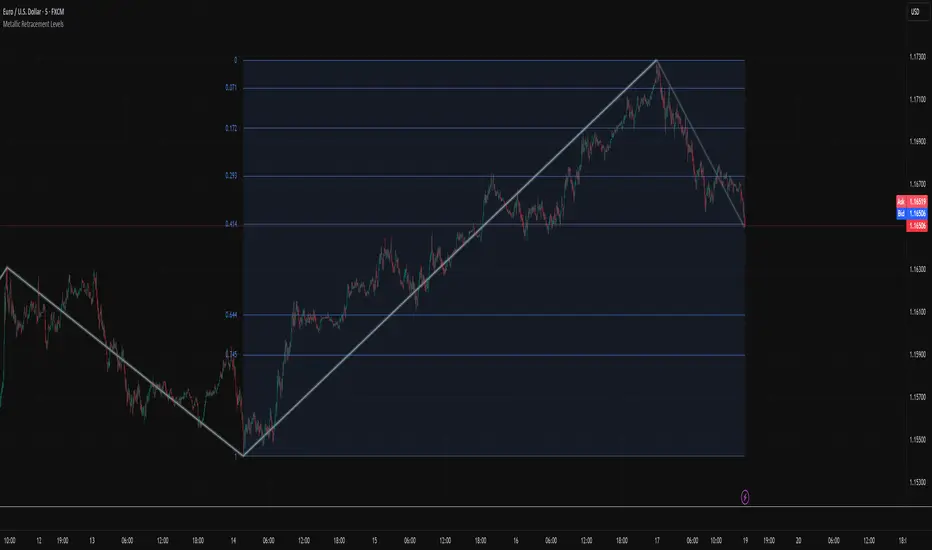
Metallic Retracement LevelsThere's something that's always bothered me about how traders use Fibonacci retracements. Everyone treats the golden ratio like it's the only game in town, but mathematically speaking, it's completely arbitrary. The golden ratio is just the first member of an infinite family of metallic means, and there's no particular reason why 1.618 should be special for markets when we have the silver ratio at 2.414, the bronze ratio at 3.303, and literally every other metallic mean extending to infinity. We just picked one and decided it was magical. The metallic means are a sequence of mathematical constants that generalize the golden ratio. They're defined by the equation x² = kx + 1, where k is any positive integer. When k equals 1, you get the golden ratio. When k equals 2, you get the silver ratio. When k equals 3, you get bronze, and so on forever. Each metallic mean generates its own set of ratios through successive powers, just like how the golden ratio gives you 0.618, 0.382, 0.236 and so forth. The silver ratio produces a completely different set of retracement levels, as does bronze, as does any arbitrary metallic number you want to choose. This indicator calculates these metallic means using the standard alpha and beta formulas. For any metallic number k, alpha equals (k + sqrt(k² + 4)) / 2, and we generate retracement ratios by raising alpha to various negative powers. The script algorithmically generates these levels instead of hardcoding them, which is how it should have been done from the start. It's genuinely silly that most fib tools just hardcode the ratios when the math to generate them is straightforward. Even worse, traditional fib retracements use 0.5 as a level, which isn't even a fibonacci ratio. It's just thrown in there because it seems like it should be important. The indicator works by first detecting swing points using the Sylvain Zig-Zag . The zig-zag identifies significant price swings by combining percentage change with ATR adjustments, filtering out noise and connecting major pivot points. This is what drives the retracement levels. Once a new swing is confirmed, the script calculates the range between the last two pivot points and generates metallic retracement levels from the most recent swing low or high. You can adjust which metallic number to use (golden, silver, bronze, or any positive integer), control how many power ratios to display above and below the 1.0 level, and set how many complete retracement cycles you want drawn. The levels extend from the swing point and show you where price might react based on whichever metallic mean you've selected. The zig-zag settings let you tune the sensitivity of swing detection through ATR period, ATR multiplier, percentage reversal, and additional absolute or tick-based reversal values. What this really demonstrates is that retracement analysis is more flexible than most traders realize. There's no mathematical law that says markets must respect the golden ratio over any other metallic mean. They're all valid mathematical constructs with the same kind of recursive properties. By making this tool, I wanted to highlight that using fibonacci retracements involves an arbitrary choice, and maybe that choice should be more deliberate or at least tested against alternatives. You can experiment with different metallic numbers and see which ones seem to work better for your particular market or timeframe, or just use this to understand that the standard fib levels everyone uses aren't as fundamental as they appear.Pine Script® Indikatorvon The_Peaceful_LizardAktualisiert 66570
AutoFib Breakout Strategy for Uptrend AssetsThis trading strategy is designed to help you catch powerful upward moves on assets that are in a long-term uptrend, such as Gold (XAUUSD). It uses a popular technical tool called the Fibonacci Extension, combined with a trend filter and a risk-managed exit system. ✅ When to Use This Strategy • Works best on higher timeframes: Daily (1D), 3-Day (3D), or Weekly (W). • Best used on uptrending assets like Gold. • Designed for swing trading – holding trades from a few days to weeks. 📊 How It Works 1. Find the Trend We only want to trade in the direction of the trend. • The strategy uses the 200-period EMA (Exponential Moving Average) to identify if the market is in an uptrend. • If the price is above the 200 EMA, we consider it an uptrend and allow long trades. 2. Identify Breakout Levels • The strategy detects recent high and low pivot points to draw Fibonacci extension levels. • It focuses on the 1.618 Fibonacci level, which is often a target in strong trends. • When the price breaks above this level in an uptrend, it signals a potential momentum breakout – a good time to buy. 3. Enter a Trade • The strategy enters a long (buy) position when the price closes above the 1.618 Fibonacci level and the market is in an uptrend (above the 200 EMA). 4. Manage Risk Automatically • The trade includes a stop-loss set to 1x the ATR (Average True Range) below the entry price – this protects against sudden drops. • It sets a take-profit at 3x the ATR above the entry – aiming for higher rewards than risks. ⚠️ Important Notes • 📈 Higher Timeframes Preferred: This strategy works best on Daily (D), 3-Day (3D), and Weekly (W) charts, especially on Gold (XAUUSD). • 🧪 Not for Deep Backtesting: Due to the nature of how pivot points and Fib levels are calculated, this strategy may not perform well in backtesting simulations (because the historical calculations can shift). It is better used for live analysis and forward testing. Pine Script® Strategievon SupertradeOfficial92
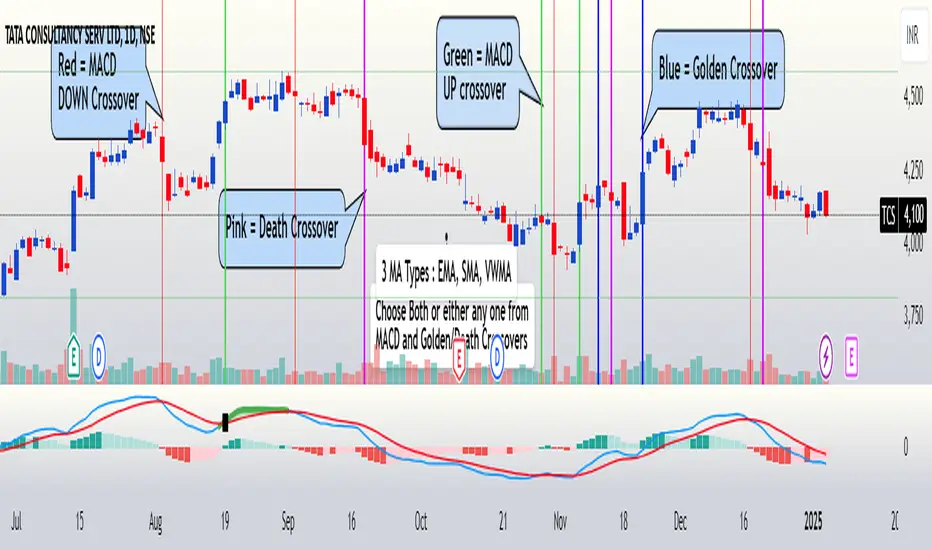
FuTech : MACD Crossovers Advanced Alert Lines============================================================= Indicator : FuTech: MACD Crossovers Advanced Alert Lines Overview: The "FuTech: MACD Crossovers Advanced Alert Lines" indicator is designed to assist traders in identifying key technical patterns using the :- 1. MACD (Moving Average Convergence Divergence) and 2. Golden/Death Crossovers By visualizing these indicators directly on the chart with advanced lines, it helps traders make more informed decisions on when to enter or exit trades. ============================================================= Key Features of "FuTech: MACD Crossovers Advanced Alert Lines": 1. MACD Crossovers: a) The MACD is one of the most widely used indicators for identifying momentum shifts and potential buy/sell signals. This indicator plots vertical lines on the chart whenever the MACD line crosses the signal line. b) Upward Crossover (Bullish Signal) : When the MACD line crosses above the signal line, a green vertical line will appear, indicating a potential buying opportunity. c) Downward Crossover (Bearish Signal) : When the MACD line crosses below the signal line, a red vertical line will appear, signaling a potential selling opportunity. 2. Golden Cross & Death Cross: a) The Golden Cross occurs when the price moves above a long-term moving average (like the 50-day moving average), signaling a potential upward trend. b) The Death Cross occurs when the price moves below a long-term moving average, signaling a potential downward trend. c) These crossovers are displayed with customizable lines on the chart to easily spot when the market is shifting direction. d) Golden Cross (Bullish Signal) : A blue vertical line appears when the price crosses above the selected long-term moving average. e) Death Cross (Bearish Signal) : A purple vertical line appears when the price crosses below the selected long-term moving average. ============================================================= Customization Options: This indicator offers several customization options to suit your trading preferences: 1) MACD Settings: a) Choose between different moving average types (EMA, SMA, or VWMA) for calculating the MACD. b) Adjust the lengths of the fast, slow, and signal MACD periods. c) Control the width and color of the vertical lines drawn on the chart for both up and down crossovers. 2) Golden Cross / Death Cross Settings: a) Select the moving average type for the Golden Cross / Death Cross (EMA, SMA, or VWMA). b) Define the lookback period for calculating the Golden Cross / Death Cross. c) Customize the appearance of the Golden and Death Cross lines, including their width and color. You can use both as well as either of the MACD lines or Golden Crossover / Death Crossover Lines respectively as per your trading strategies ============================================================= How "FuTech: MACD Crossovers Advanced Alert Lines" indicator Works: a) The indicator monitors the price and calculates the MACD and Golden/Death Crosses. b) When the MACD line crosses above or below the signal line, or when the price crosses above or below the long-term moving average, it plots a vertical line on the chart. c) These lines help traders quickly spot potential turning points in the market, providing clear signals to act upon. ============================================================= Use Case: a) Swing Traders: The indicator is useful for spotting momentum shifts and trend reversals, helping you time entries and exits for short- to medium-term trades. b) Long-Term Traders: The Golden and Death Cross signals help identify major trend changes, giving insights into potential market shifts. ============================================================= Why Use This "FuTech: MACD Crossovers Advanced Alert Lines" Indicator ? a) Clear Visuals : The vertical lines provide clear and easy-to-spot signals for MACD crossovers and Golden/Death Crosses. b) Customizable : Adjust settings for your personal trading strategy, whether you're focusing on short-term momentum or long-term trend shifts. c) Supports Decision Making : With its advanced line plotting and customizable features, this indicator helps you make quicker and more informed trading decisions. ============================================================= How to Use: a) MACD Crossovers: Look for green lines to signal potential buying opportunities (when the MACD line crosses above the signal line) and red lines for selling opportunities (when the MACD line crosses below the signal line). b) Golden Cross / Death Cross: Use the blue lines to confirm when a positive trend may begin (Golden Cross) and purple lines to warn when a negative trend may start (Death Cross). ============================================================= Conclusion: "FuTech: MACD Crossovers Advanced Alert Lines" indicator combines two powerful technical analysis tools, the MACD and Golden/Death Crosses, to provide clear, actionable signals on your chart. By customizing the appearance of these signals and combining them with your trading strategy, you can enhance your decision-making process and improve your trading outcomes. ============================================================= Thank you ! Jai Swaminarayan Dasna Das ! He Hari ! Bas Ek Tu Raji Tha ! =============================================================Pine Script® Indikatorvon Atmiya_aatubhaiAktualisiert 79
CE - 42MACRO Fixed Income and Macro This is Part 2 of 2 from the 42MACRO Recreation Series However, there will be a bonus Indicator coming soon! The CE - 42MACRO Fixed Income and Macro Table is a next level Macroeconomic and market analysis indicator. It aims to provide a probabilistic insight into the market realized GRID Macro regimes, track a multiplex of important Assets, Indices, Bonds and ETF's to derive extra market insights by showing the most important aggregates and their performance over multiple timeframes... and what that might mean for the whole market direction. For traders and especially investors, the unique functionalities will be of high value. Quick guide on how to use it: docs.google.com WARNING By the nature of the macro regimes, the outcomes are more accurate over longer Chart Timeframes (Week to Months). However, it is also a valuable tool to form an advanced, market realized, short to medium term bias. NOTE This Indicator is intended to be used alongside the 1nd part "CE - 42MACRO Equity Factor" for a more wholistic approach and higher accuracy. Methodology: The Equity Factor Table tracks specifically chosen Assets to identify their performance and add the combined performances together to visualize 42MACRO's GRID Equity Model. For this it uses the below Assets: Convertibles ( AMEX:CWB ) Leveraged Loans ( AMEX:BKLN ) High Yield Credit ( AMEX:HYG ) Preferreds ( NASDAQ:PFF ) Emerging Market US$ Bonds ( NASDAQ:EMB ) Long Bond ( NASDAQ:TLT ) 5-10yr Treasurys ( NASDAQ:IEF ) 5-10yr TIPS ( AMEX:TIP ) 0-5yr TIPS ( AMEX:STIP ) EM Local Currency Bonds ( AMEX:EMLC ) BDCs ( AMEX:BIZD ) Barclays Agg ( AMEX:AGG ) Investment Grade Credit ( AMEX:LQD ) MBS ( NASDAQ:MBB ) 1-3yr Treasurys ( NASDAQ:SHY ) Bitcoin ( AMEX:BITO ) Industrial Metals ( AMEX:DBB ) Commodities ( AMEX:DBC ) Gold ( AMEX:GLD ) Equity Volatility ( AMEX:VIXM ) Interest Rate Volatility ( AMEX:PFIX ) Energy ( AMEX:USO ) Precious Metals ( AMEX:DBP ) Agriculture ( AMEX:DBA ) US Dollar ( AMEX:UUP ) Inverse US Dollar ( AMEX:UDN ) Functionalities: Fixed Income and Macro Table Shows relative market Asset performance Comes with different Calculation options like RoC, Sharpe ratio, Sortino ratio, Omega ratio and Normalization Allows for advanced market (health) performance Provides the calculated, realized GRID market regimes Informs about "Risk ON" and "Risk OFF" market states Visuals - for your best experience only use one (+ BarColoring) at a time: You can visualize all important metrics: - GRID regimes of the currently chosen calculation type - Risk On/Risk Off with background colouring and additional +1/-1 values - a smoother GRID model - a smoother Risk On/ Risk Off metric - Barcoloring for enabled metric of the above If you have more suggestions, please write me Fixed Income and Macro: The visualisation of the relative performance of the different assets provides valuable information about the current market environment and the actual market performance. It furthermore makes it possible to obtain a deeper understanding of how the interconnected market works and makes it simple to identify the actual market direction, thus also providing all the information to derive overall market health, market strength or weakness. Utility: The Fixed Income and Macro Table is divided in 4 Columns which are the GRID regimes: Economic Growth: Goldilocks Reflation Economic Contraction: Inflation Deflation Top 5 Fixed Income/ Macro Factors: Are the values green for a specific Column? If so then the market reflects the corresponding GRID behavior. Bottom 5 Fixed Income/ Macro Factors: Are the values red for a specific Column? If so then the market reflects the corresponding GRID behavior. So if we have Goldilocks as current regime we would see green values in the Top 5 Goldilocks Cells and red values in the Bottom 5 Goldilocks Cells. You will find that Reflation will look similar, as it is also a sign of Economic Growth. Same is the case for the two Contraction regimes. ****** This Indicator again is based to a majority on 42MACRO's models. I only brought them into TV and added things on top of it. If you have questions or need a more in-depth guide DM me. GM Pine Script® Indikatorvon Celestial-EyeAktualisiert 44339
CE - 42MACRO Equity Factor Table This is Part 1 of 2 from the 42MACRO Recreation Series The CE - 42MACRO Equity Factor Table is a whole toolbox packaged in a single indicator. It aims to provide a probabilistic insight into the market realized GRID Macro Regime, use a multiplex of important Assets and Indices to form a high probability Implied Correlation expectation and allows to derive extra market insights by showing the most important aggregates and their performance over multiple timeframes... and what that might mean for the whole market direction, as well as the underlying asset. WARNING By the nature of the macro regimes, the outcomes are more accurate over longer Chart Timeframes (Week to Months). However, it is also a valuable tool to form a proper, market realized, short to medium term bias. NOTE This Indicator is intended to be used alongside the 2nd part "CE - 42MACRO Yield and Macro" for a more wholistic approach and higher accuracy. Due to coding limitations they can not be merged into one Indicator. Methodology: The Equity Factor Table tracks specifically chosen Assets to identify their performance and add the combined performances together to visualize 42MACRO's GRID Equity Model. For this it uses the below Assets, with more to come: Dividend Compounders ( AMEX:SPHD ) Mid Caps ( AMEX:VO ) Emerging Markets ( AMEX:EEM ) Small Caps ( AMEX:IWM ) Mega Cap Growth ( NASDAQ:QQQ ) Brazil ( AMEX:EWZ ) United Kingdom ( AMEX:EWU ) Growth ( AMEX:IWF ) United States ( AMEX:SPY ) Japan ( AMEX:DXJ ) Momentum ( AMEX:MTUM ) China ( AMEX:FXI ) Low Beta ( AMEX:SPLV ) International ex-US ( NASDAQ:ACWX ) India ( AMEX:INDA ) Eurozone ( AMEX:EZU ) Quality ( AMEX:QUAL ) Size ( AMEX:OEF ) Functionalities: 1. Correlations Takes a measure of Cross Market Correlations 2. Implied Trend Calculates the trend for each Asset and uses the Correlation to obtain the Implied Trend for the underlying Asset There are multiple functionalities to enhance Signal Speed and precision... Reading a signal only over a certain threshold, otherwise being colored in gray to signal noise or unclear market behavior Normalization of Signal Double Normalization of Signal for more Speed... ideal for the Crypto Market Using an additional Hull Moving Average to enhance Signal Speed Additional simple Background coloring to get a Signal from the HMA Barcoloring based on the Implied Correlation 3. Equity Factor Table Shows market realized Asset performance Provides the approximate realized GRID market regimes Informs about "Risk ON" and "Risk OFF" market states Now into the juicy stuff... Visuals: There is a variety of options to change visual settings of what is plotted and where + additional considerations. Everything that is relevant in the underlying logic which can improve comprehension can be visualized with these options. More to come Market Correlation: The Market Correlation Table takes the Correlation of all the Assets to the Asset on the Chart, it furthermore uses the Normalized KAMA Oscillator by IkkeOmar to analyse the current trend of every single Asset. (To enhance the Signal you can apply the mentioned Indicator on the relevant Assets to find your target Asset movements that you intend to capture... and then change the length of the Indicator in here) It then Implies a Correlation based on the Trend and the Correlation to give a probabilistically adjusted expectation for the future Chart Asset Movement. This is strengthened by taking the average of all Implied Trends. Thus the Correlation Table provides valuable insights about probabilistically likely Movement of the Asset over the defined time duration, providing alpha for Traders and Investors alike. Equity Factors: The table provides valuable information about the current market environment (whether it's risk on or risk off), the rough GRID models from 42MACRO and the actual market performance. This allows you to obtain a deeper understanding of how the market works and makes it simple to identify the actual market direction, makes it possible to derive overall market Health and shows market strength or weakness. Utility: The Equity Factor Table is divided in 4 Sections which are the GRID regimes: Economic Growth: Goldilocks Reflation Economic Contraction: Inflation Deflation Top 5 Equity Factors: Are the values green for a specific Column? If so then the market reflects the corresponding GRID behavior. Bottom 5 Equity Factors: Are the values red for a specific Column? If so then the market reflects the corresponding GRID behavior. So if we have Goldilocks as current regime we would see green values in the Top 5 Goldilocks Cells and red values in the Bottom 5 Goldilocks Cells. You will find that Reflation will look similar, as it is also a sign of Economic Growth. Same is the case for the two Contraction regimes. This whole Indicator, as well as the second part, is based to a majority on 42MACRO's models. I only brought them into TV and added things on top of it. If you have questions or need a more in-depth guide DM me. Will make a guide to all functionalities if necessity becomes apparent. GM Pine Script® Indikatorvon Celestial-EyeAktualisiert 1919625
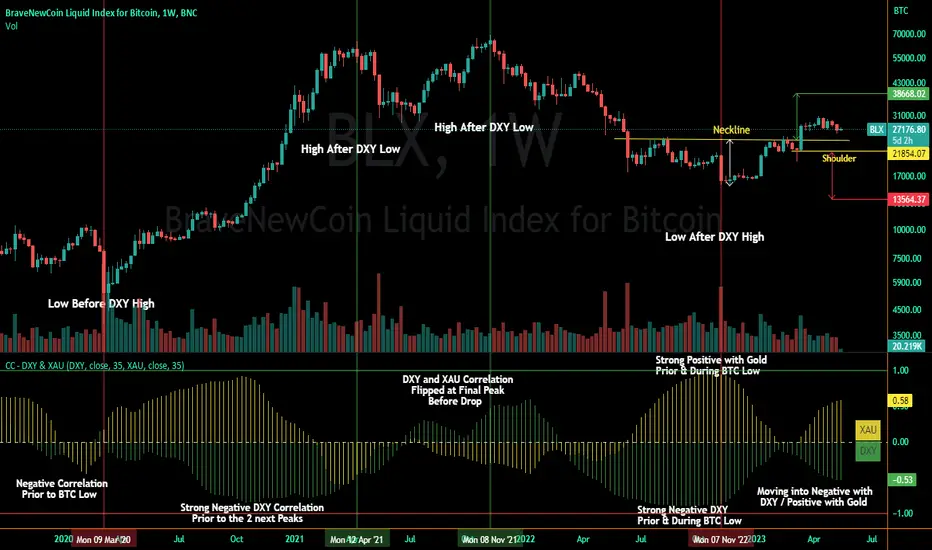
Correlation Coefficient - DXY & XAUPublishing my first indicator on TradingView. Essentially a modification of the Correlation Coefficient indicator, that displays a 2 ticker symbols' correlation coefficient vs, the chart presently loaded.. You can modify the symbols, but the default uses DXY and XAU, which have been displaying strong negative correlation. As with the built-in CC (Correlation Coefficient) indicator, readings are taken the same way: Positive Correlation = anything above 0 | stronger as it moves up towards 1 | weaker as it moves back down towards 0 Negative Correlation = anything below 0 | stronger moving down towards -1 | weaker moving back up towards 0 This is primarily created to work with the Bitcoin weekly chart, for comparing DXY and Gold (XAU) price correlations (in advance, when possible). If you change the chart timeframe to something other than weekly, consider playing with the Length input, which is set to 35 by default where I think it best represents correlations with Bitcoin's weekly timeframe for DXY and Gold. The intention is that you might be able to determine future direction of Bitcoin based on positive or negative correlations of Gold and/or the US Dollar Index. DXY has been making peaks and valleys prior to Bitcoin since after March 2020 black swan event, where it peaked just after instead. In the future, it may flip over again and Bitcoin may hit major highs or lows prior to DXY, again. So, keep an eye on the charts for all 3, as well as the indicator correlations. Currently, we've moved back into negative correlation between Bitcoin and DXY, and positive correlation with Bitcoin and Gold: Negative Correlation b/w Bitcoin and DXY - if DXY moves up, Bitcoin likely moves down, or if DXY moves down, Bitcoin likely moves up (or if Bitcoin were to move first before DXY, as it did on March 2020, instead) Positive Correlation b/w Bitcoin and Gold - Bitcoin and Gold will likely move up or down with each other. DXY is represented by the green histogram and label, Gold is represented by the yellow histogram and label. Again, you can modify the tickers you want to check against, and you can modify the colors for their histograms / labels. The inspiration from came from noticing areas of same date or delayed negative correlation between Bitcoin and DXY, here is one of my most recent posts about that: Please let me know if you have any questions, or would like to see updates to the indicator to make it easier to use or add more useful features to it. I hope this becomes useful to you in some way. Thank you for your support! Cheers, dudebruhwhoa :)Pine Script® Indikatorvon dudebruhwhoa22410
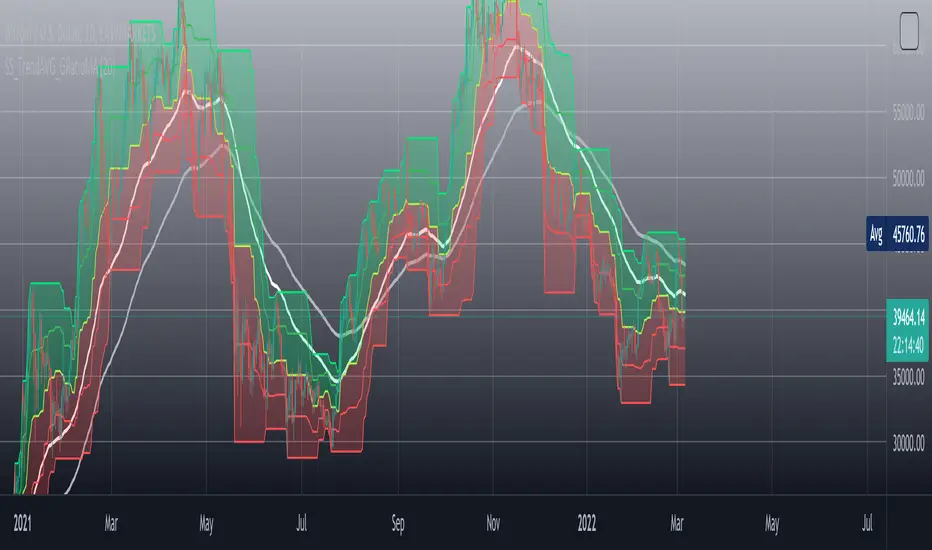
[SS]_TrendAVGZones_and_GoldenRatioMAThe _TrendAVGZones_and_GoldenRatioMA is an indicator that is composed first of a channel made of three price averages ( base average, middle lower and middle upper ) in red is the previous corrections average and in green the previous rises average. So that way we the setting of stop loss targets and price targets can be set up at first glance. It adjusts to any timeframe so no worries 'bout that. Also I added two exponential moving averages ( white and silver lines ) on the chart which I modified their equations by multiplying as it follows : is the simple modification I added to fine tune it's precision and after some trials and errors I finally found a perfect spot. Now I tried it with historical data of Bitcoin and when the two Golden Ratio EMA crosses there's a big move coming imminently : if the white one is on top of the silver one the trend is bullish inversely the white one finds itself under the silver line then it needs to cross to expect a reversal. rphi = 0.6180339887498948 = is the conjugate root of the golden ratio also called the silver ratio phi = 1.6180339887498948 = golden ratio It should be used to find short to mid term price targets selling as well as buying ones. If you're a long term trader I suggest using trend lines analysis in combination with it. I hope to make this indicator a community owned indicator so don't hesitate to perfect it so we can build the best tool traders can hope for ! Together we will no longer ask wen lambo? we will get it! IF you've got any question you can always DM me take care of yourselves you future millionaires :D -SSPine Script® Indikatorvon SatoShinobi20
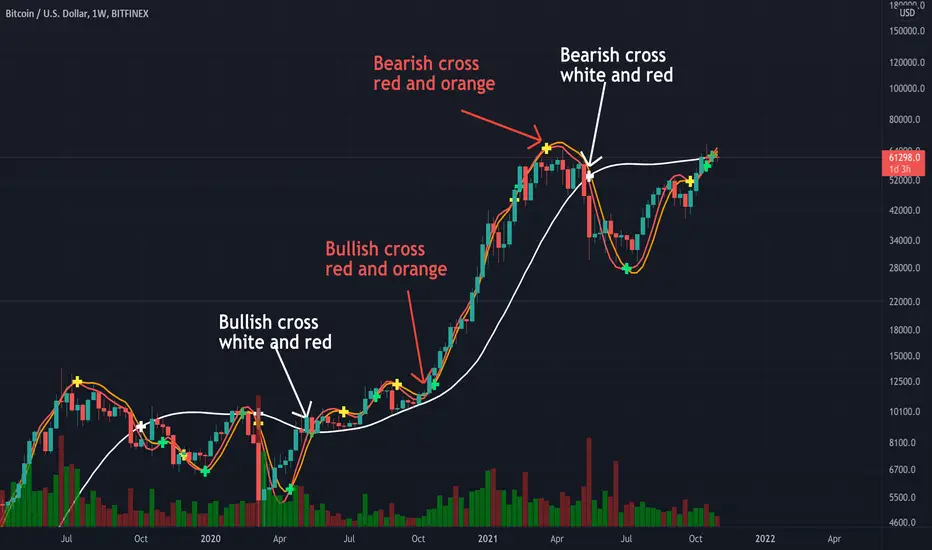
Triple Modified Hull Moving Average Cross By <Zakaria>Triple Modified Hull Moving Average Cross By What is this? this is a modified formula for Hull moving average, it is more accurate and predicts the golden and death cross earlier. How to use? Work better in high time frames (1D,1W) the white line vs the red and the orange lines : 1 - when the white line crosses the red and the orange lines from the bottom the price will go down . Death cross! 2 - when the white line crosses the red and the orange lines from the top the price will go up . Golden Cross! the red line vs the orange line : 1- when the orange line crosses the red line from the bottom the price will go down . Death cross! 2 - when the orange line crosses the red line from the top the price will go up . Golden Cross! p.s: the lag between these two lines will be very small. use it in the 1W time frame to predict where exactly the bull market will end. You can input your personalized values if you want!Pine Script® Indikatorvon zakarididiAktualisiert 55450
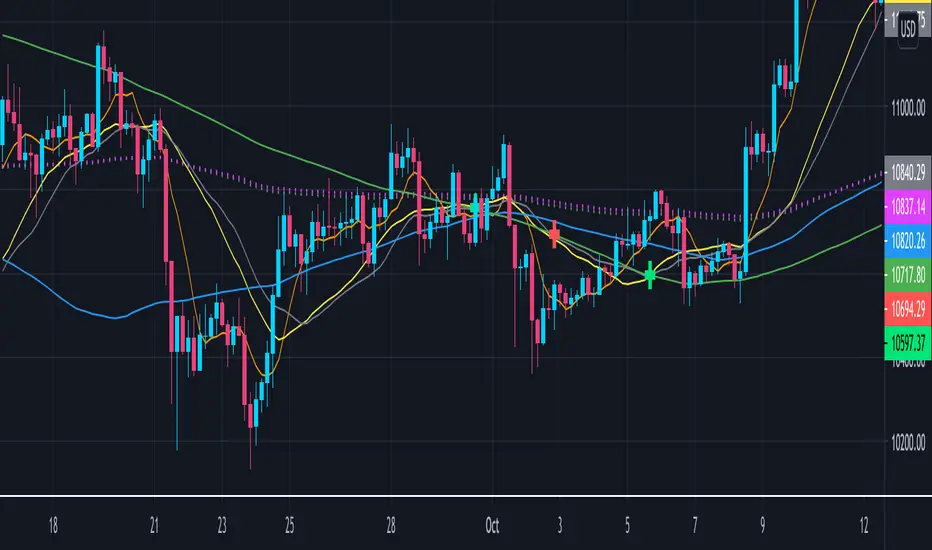
Crypto EMA+MA+MACS by hobbeLeThis is an indicator that includes several EMAs and MAs (Used in Cryptotrading). In addition, the Golden and Death Cross are also displayed. Used MAs MA 7 - Orange Line MA 21 - Yellow Line MA 25 - Grey Line MA 99 - Blue Line MA 200 - Green Line Used EMAs EMA 200 - Grey Dotted Line EMA 222 - Pink Dotted Line Golden Cross Crossover MA25 + MA200 Death Cross Crossunder MA25 + MA200 What is a Moving Average (MA) ? A moving average (MA) is a widely used indicator in technical analysis that helps smooth out price action by filtering out the “noise” from random short-term price fluctuations. Moving average is a trend-following, or lagging, indicator because it is based on past prices. The most common applications of moving averages are: to identify the trend direction to determine support and resistance levels The two basic and commonly used moving averages are the simple moving average ( SMA ), which is the arithmetic average of a security over a defined number of time periods, and the exponential moving average ( EMA ), which gives greater weight to more recent prices. What is a Golden Cross? The golden cross is a candlestick pattern that is a bullish signal in which a relatively short-term moving average crosses above a long-term moving average. The golden cross is a bullish breakout pattern formed from a crossover involving a security's short-term moving average (such as the 15-day moving average) breaking above its long-term moving average (such as the 50-day moving average) or resistance level. As long-term indicators carry more weight, the golden cross indicates a bull market on the horizon and is reinforced by high trading volumes. What Is a Death Cross? The death cross is a technical chart pattern indicating the potential for a major selloff. The death cross appears on a chart when a stock’s short-term moving average crosses below its long-term moving average. Source; Investopedia Pine Script® Indikatorvon hobbeLe33112
Ultimate Moving Averages (SMA & EMA)Welcome to the Ultimate Moving Average indicator. Never again spend time looking for EMA / SMA indicators when you can have them all in this single indicator. Options include : Daily Chart: Classic Golden / Death Cross - 50/D and 200/D SMA Daily Chart: 3-day Golden / Death Cross - 150/D and 600/D SMA Daily Chart: 140/D SMA Daily Chart: 700/D SMA Daily Chart: 1458/D SMA Daily Chart: Golden Ratio Multiplier Any Chart: Scalping 9 SMA 10 SMA 20 SMA 21 SMA 30 SMA 34 SMA 50 SMA 80 SMA 100 SMA 200 SMA 8 EMA 10 EMA 13 EMA 20 EMA 21 EMA 26 EMA 30 EMA 34 EMA 50 EMA 55 EMA 80 EMA 89 EMA 100 EMA 200 EMA Pine Script® Indikatorvon SignalyzeHQAktualisiert 118
Rhaps SMAEMA Combo v1.1There's many versions of this sort of thing around the Tradingview library, but i guess we all like things to our own specifications. So this is my take on the SMA and EMA version combined. Bunch of SMA's & EMA's, with labels, and G&D Cross Labels and Alerts. These values can of course be changed to any you may prefer. Rhapsodyy's Combo SMAEMA's v1.1 SMA's with Painted Labels : 10/30/50/80/200 EMA's with Painted Labels : 21/50/89/200/377 50SMA / 200SMA Golden & Death Crosses on Current Timeframe & Alerts Daily 50SMA / 200SMA Golden & Death Crosses overlayed onto Current Timeframe & Alerts 50EMA / 200EMA Golden & Death Crosses on Current Timeframe & Alerts Daily 50EMA / 200EMA Golden & Death Crosses overlayed onto Current Timeframe & AlertsPine Script® Indikatorvon RhapsodyyAktualisiert 2261
Eagle-CrossingThis is Arcane Bears First Script Which charts your Golden Cross and Death Cross, You can update the settings as you see fit! If you have any questions please join us at www.arcanebear.com Pine Script® Indikatorvon Arcane-bear22479
MACD Divergence Detector (with Golden/Death Cross)█ OVERVIEW This indicator combines the classic MACD with automatic divergence detection and golden/death cross signals, giving traders a comprehensive momentum analysis tool in a single overlay. █ FEATURES • Standard MACD (12/26/9) with fully customizable parameters • Color-coded histogram: distinguishes between growing and fading momentum in both bullish and bearish phases • Automatic Regular Bullish Divergence detection (labeled "底" — Bottom) • Automatic Regular Bearish Divergence detection (labeled "顶" — Top) • Golden Cross / Death Cross markers with configurable lookback range • All detection ranges are adjustable to suit different timeframes and trading styles █ HOW IT WORKS Divergence Detection: The indicator identifies pivot highs and pivot lows on the MACD line, then compares them with price action. When price makes a lower low but MACD makes a higher low, a bullish divergence is flagged. When price makes a higher high but MACD makes a lower high, a bearish divergence is flagged. Cross Signals: Golden crosses (MACD crossing above signal) and death crosses (MACD crossing below signal) are marked with green and red dots respectively, filtered by a user-defined range to avoid redundant signals. █ SETTINGS — MACD Fast Length (default: 12) — MACD Slow Length (default: 26) — Signal Length (default: 9) — Pivot Lookback Left/Right (default: 5/5) — Divergence Range (default: 5–60 bars) — Cross Range (default: 5–60 bars) — Fully customizable colors for MACD line, signal line, and histogram █ USAGE TIPS • Works on all timeframes; higher timeframes (4H, Daily) tend to produce more reliable divergence signals • Combine with support/resistance levels or volume analysis for confirmation • Adjust the lookback range to filter noise on lower timeframes • Divergence signals appear with a slight delay (equal to the right pivot lookback) for confirmation accuracyPine Script® Indikatorvon dylancui96
BTC Market Cap / Global M2 weighted by GoldThe market cap of Bitcoin divided by the M2 money supply of a collection of the worlds fiat currencies converted into USD and weighted by the price of gold.Pine Script® Indikatorvon benloveslamp2
GS Fibonacci Retracement Dynamic Anchor [Buy/Sell]GS Fibonacci Retracement Dynamic Anchor: Institutional Reversal Logic The GS Fibonacci Retracement Dynamic Anchor is a high-precision Fibonacci tool designed for various assets including Stocks, Forex, and Options. Instead of static lines that become irrelevant as price moves, this script uses a rolling lookback engine to find the absolute Current Range . It then projects a "live grid" starting exactly from the highest and lowest bar indices. How the Signals Work (Careful Entry): This script does not just signal because a line was touched. It uses a Validation Phase : The Pocket Entry: For a BUY signal, price must first dip into the "Golden Pocket" (below the 61.8% line). For a SELL signal, price must rise into the "Premium Pocket" (above 38.2%). The Verification: The arrow only appears when the price closes back across the 50% Median Line . This confirms that the trend has truly shifted and the high/low is locked in. Does this Redraw? The Lines: Yes. The lines are Dynamic . If the market makes a higher high, the Fibonacci levels will automatically recalculate and shift up. This ensures you are always looking at the most current mathematical reality. The Signals (Arrows): NO. The BUY and SELL arrows are calculated based on bar closes. Once an arrow appears on a closed candle, the logic is locked to that historical data. Main Trading Applications: Forex & Stocks: Ideal for catching "Mean Reversion." When a stock is overextended and enters the Premium Zone, the GS SELL signal helps you exit or short before the drop back to the median. Options: The GS BUY signals represent "Deep Discount" entries where the Greeks (Delta/Theta) are most favorable for a bounce. Equities/Funds: High-reliability signals for long-term investors to find "The Bottom" of a 75-day consolidation. Key Features: Institutional Ratios: Tracks the 21.0, 38.2, 50.0, 61.8, and 79.0 levels—the specific decimals used by automated trading algorithms. Dynamic Anchor Dashboard: Real-time tracking of whether the price is in a "Premium" (Expensive) or "Discount" (Cheap) state. Alert Ready: Fully integrated alert conditions for both Bullish and Bearish confirmations. Points to Note: Trend Strength: If the market is in a "Super Trend" (making new highs every 3 bars), the anchors will shift frequently. In these cases, wait for the price to stop making new anchors before trusting the 50% reclaim. Lookback Setting: The 75-bar default is the "Sweet Spot" for most traders. Shortening it to 30 will make it a scalping tool; lengthening it to 200 will make it a macro-trend tool. Pine Script® Indikatorvon Finis2331129
XAU 15m Impulse + Golden Pocket + TP/SL1) What the indicator does This tool automatically detects the latest confirmed impulse move on the 15‑minute timeframe, regardless of what timeframe you’re currently viewing (2m, 5m, 15m, etc.). An “impulse” here means: a confirmed pivot‑to‑pivot movement that is large enough (based on ATR × minimum multiplier) and clearly directional (UP or DOWN) From that impulse the script automatically draws: Golden Pocket retracement zone (0.618–0.65) SL level (0.855 retracement) TP1 at 0.0 (origin of impulse) TP2 at –0.382 extension (continuation target) 2) What you see on the chart Golden Pocket (GP) zone Displayed as a dark orange box between 0.618 and 0.65. Framed by dashed orange lines for clear visibility. Automatically updates when a new impulse forms. SL, TP1, TP2 lines SL (0.855 retracement): red line TP1 (0.0): lime-green line TP2 (–0.382 extension): darker green line Auto‑extended far into the future for planning trades. Labels “GP 0.618‑0.65” “TP1 (0.0)” “TP2 (‑0.382)” “SL (0.855)” These appear at the far right of your chart for clarity. 3) How the impulse is detected The script constantly watches 15m pivots: Pivot Low → Pivot High forms a potential UP impulse Pivot High → Pivot Low forms a potential DOWN impulse A swing becomes a valid impulse only when: It is a confirmed pivot It is big enough (range ≥ ATR × minAtrMult) It has correct pivot direction (low→high or high→low) Only the most recent valid impulse is used. 4) How to use it for trading Long setup (UP impulse) Identify the UP impulse box on the chart Price retraces into the orange GP zone (0.618–0.65) Watch for: rejection candles liquidity spikes your LTF scalping model (EMA 9/21) Enter long from GP → target: TP1 = 0.0 (end of impulse) TP2 = –0.382 (extension above the impulse high) Stop‑loss: SL = 0.855 retracement (red line) Short setup (DOWN impulse) The exact mirror: GP zone above price between 0.618–0.65 TP1 at the impulse low TP2 below (–0.382 extension) SL higher at 0.855 5) Why these levels matter Golden Pocket 0.618–0.65 The most commonly respected Fibonacci retracement cluster Preferred by institutional algo models and liquidity traders High‑probability reversal zone SL at 0.855 retracement Last “deep retracement” before a trend is considered broken Used by many professional trade‑management models Keeps SL outside common stop‑hunt zones TP1 at 0.0 Logical first target: retest of impulse origin Safe, high‑probability take‑profit TP2 at –0.382 Measures continuation strength Great extended target for trending days Works particularly well on gold (XAUUSD) 6) When NOT to use signals Avoid entries when: Trend is extremely weak or flat Major news events are hitting soon Price is consolidating above/below the GP zone without reaction A new impulse has not yet been formed (indicator looks “gray”) 7) Best way to combine it with your scalping model Your scalping system (EMA 9/21 pullback + BOS + volume) works perfectly with this: Ideal long confluence 15m impulse is UP Price retraces to GP zone On 2m/5m: EMA9 > EMA21 Reclaim EMA9 BOS UP Volume confirmation Enter → TP1 / TP2 The GP acts as your HTF premium discount zone, and your entries are timed on LTF momentum structure. 8) Default settings reference Impulse timeframe: 15m Pivot size: 3×3 Min impulse size: ATR(14) × 1.2 Extend lines: 500 bars GP opacity: 60 (dark orange)Pine Script® Indikatorvon lucinka_krchlikova10