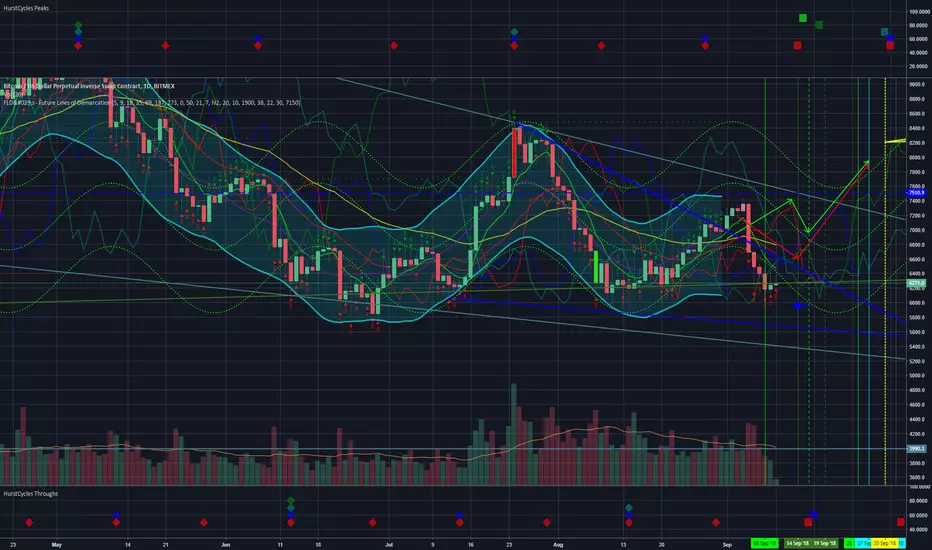
HurstCycles PeaksOnly way I found to plot hurst cycles. I gave up on anything other than daily chart. Published on request.Pine Script® Indikatorvon redevil5k88433
HurstCycles ThroughsOnly way I found to plot hurst cycles. I gave up on anything other than daily chart. Published on request.Pine Script® Indikatorvon redevil5k44320
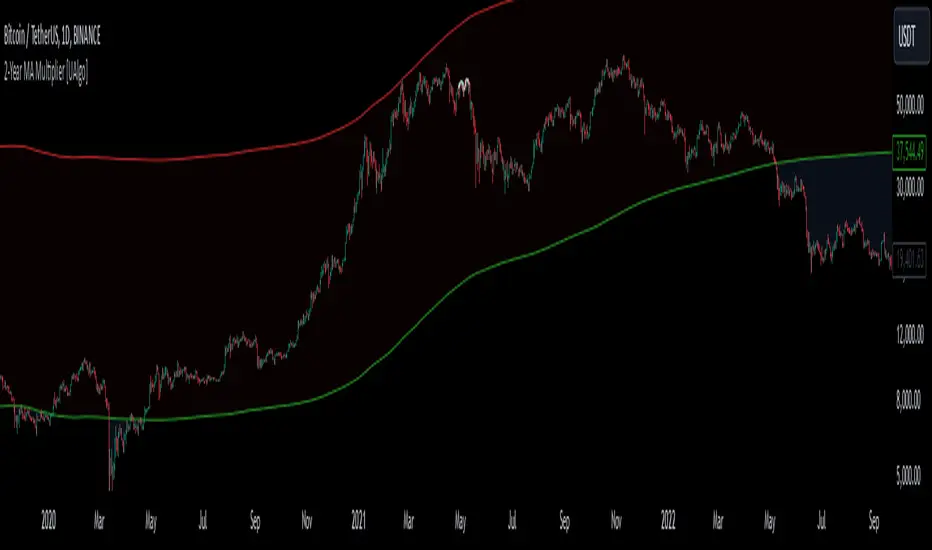
2-Year MA Multiplier [UAlgo]The 2-Year MA Multiplier is a technical analysis tool designed to assist traders and investors in identifying potential overbought and oversold conditions in the market. By plotting the 2-year moving average (MA) of an asset's closing price alongside an upper band set at five times this moving average, the indicator provides visual cues to assess long-term price trends and significant market movements. 🔶 Key Features 2-Year Moving Average (MA): Calculates the simple moving average of the asset's closing price over a 730-day period, representing approximately two years. Visual Indicators: Plots the 2-year MA in forest green and the upper band in firebrick red for clear differentiation. Fills the area between the 2-year MA and the upper band to highlight the normal trading range. Uses color-coded fills to indicate overbought (tomato red) and oversold (cornflower blue) conditions based on the asset's closing price relative to the bands. 🔶 Idea The concept behind the 2-Year MA Multiplier is rooted in the cyclical nature of markets, particularly in assets like Bitcoin. By analyzing long-term price movements, the indicator aims to identify periods of significant deviation from the norm, which may signal potential buying or selling opportunities. 2-year MA smooths out short-term volatility, providing a clearer view of the asset's long-term trend. This timeframe is substantial enough to capture major market cycles, making it a reliable baseline for analysis. Multiplying the 2-year MA by five establishes an upper boundary that has historically correlated with market tops. When the asset's price exceeds this upper band, it may indicate overbought conditions, suggesting a potential for price correction. Conversely, when the price falls below the 2-year MA, it may signal oversold conditions, presenting potential buying opportunities. 🔶 Disclaimer Use with Caution: This indicator is provided for educational and informational purposes only and should not be considered as financial advice. Users should exercise caution and perform their own analysis before making trading decisions based on the indicator's signals. Not Financial Advice: The information provided by this indicator does not constitute financial advice, and the creator (UAlgo) shall not be held responsible for any trading losses incurred as a result of using this indicator. Backtesting Recommended: Traders are encouraged to backtest the indicator thoroughly on historical data before using it in live trading to assess its performance and suitability for their trading strategies. Risk Management: Trading involves inherent risks, and users should implement proper risk management strategies, including but not limited to stop-loss orders and position sizing, to mitigate potential losses. No Guarantees: The accuracy and reliability of the indicator's signals cannot be guaranteed, as they are based on historical price data and past performance may not be indicative of future results.Pine Script® Indikatorvon UAlgo11357
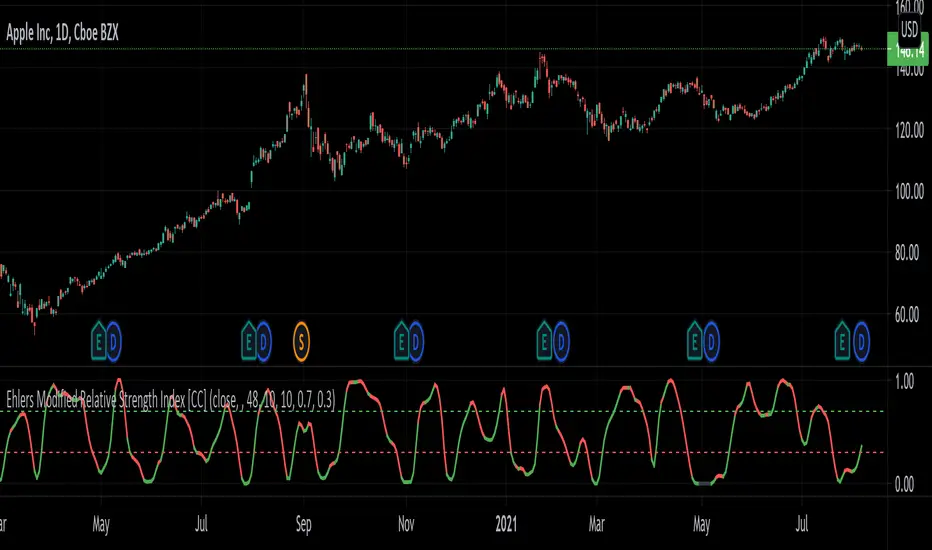
Ehlers Modified Relative Strength Index [CC]The Modified Relative Strength Index was created by John Ehlers (Cycle Analytics For Traders pgs 87-88) and this is a typical RSI that uses his roofing filter as the input. He smooths it with his own super smoother filter to provide signals. This indicator is extremely reactive and works in cycles so keep that in mind. I haven't been able to come up with clear buy and sell signals at this point so let me know if you any suggestions but I'm publishing the code to complete my goal of publishing all of his work one day. I will be publishing a bunch of Ehlers scripts in the next few weeks so stay tuned. What I recommend for buy and sell signals at this point are to buy when the indicator goes below the oversold line and starts going up and sell when the indicator goes below the oversold line a second time. Vice versa for sell signals. Let me know if there are any other scripts you would like to see me publish!Pine Script® Indikatorvon cheatcountry118
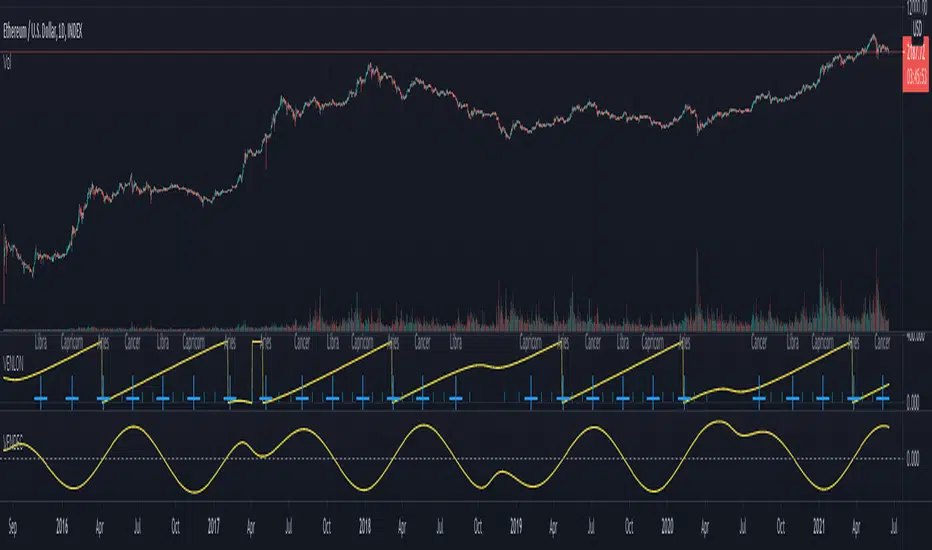
Financial Astrology Venus LongitudeVenus energy influence the affections, beauty, passion, arts, festivities, finance, marriage, speculation. As a traders the Venus cycle will determine the affection, love and interest we manifest for specific industries that we perceive more fascinating and seductive for our speculation purposes. Financial astrologer Bill Meridian suggest that Venus rules the industries of "recreation, cosmetics, fashion, leisure". Personally I believe that the affection to hold shares within specific industries will be determined by the zodiac sign position of Venus. For example, Venus in Aries will rule sports, war industry, high risk and volatility, in Taurus the land, agriculture, cattle raising, banks, exchanges and and desire for stability, in Gemini the mass media, newspapers, marketing, publishing house, conferences and desire to discuss the trending topics, in Cancer the real state, bars and restaurants, fishing and so forth with the standard zodiac sign industries rulership. Therefore, traders will feel more affection for the industries / emotional behavior ruled by the sign that Venus is transiting. Therefore, as Venus transition to other signs that are incompatible with an industry characteristics, that desire to hold shares in a given industry would diminish. Within the financial astrology research we have identified that the BTCUSD bullish Venus zodiac signs are: Aries, Gemini, Leo, Virgo, Scorpio, Aquarius and Pisces. The bearish signs are: Taurus, Cancer, Libra and Capricorn. The other signs show mixed results. As expected, Aquarius was a prominent position due to the fact that represent "technology and innovation", Pisces seem very relevant because represent the destruction of the previous model, the end of the traditional banks financial system in favor of the decentralized finances (DeFI) approach. Aries, because is the entrepreneurship spirit of the new opportunities that arise with this financial system transition where masses are willing to start trying, exploring and taking risks (adventures) in this alternative way to manage and storing your assets. Leo because cryptocurrencies is the new tech fashion and hot speculation area. Virgo because it provide a perfect immutable decentralised database (the blockchain) that couldn't be altered or manipulated so is precise and exact financial system that correlate well with the precision and exactness affection we feel within Virgo influence. With this indicator there is unlimited possibilities to explore across different markets to strudy how the Venus energy influence plays out, no more manual chart annotations to identify the zodiac sign location of Venus. We encourage you to analyze this zodiac sign cycles in different markets and share with us your observations, leave us a comment with your research outcomes. Happy research! Note: The Venus tropical longitude indicator is based on an ephemeris array that covers years 2010 to 2030, prior or after this years the longitude is not available, this daily ephemeris are based on UTC time so in order to align properly with the price bars times you should set UTC as your chart reference timezone. Pine Script® Indikatorvon citlacomAktualisiert 44112
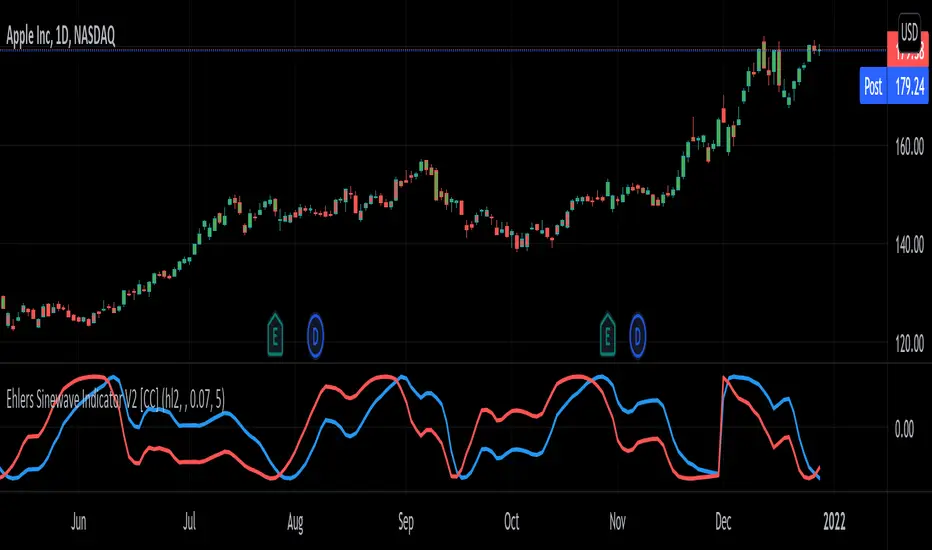
Ehlers Sinewave Indicator V2 [CC]The Sinewave Indicator was created by John Ehlers (Cybernetic Analysis For Stocks And Futures pgs 154-155) and this is an updated version of his original Sinewave Indicator which in my opinion seems to be more reactive to changes. Buy when the blue line crosses over the red line and sell when the blue line crosses under the red line. Also keep in mind that this indicator is based on cycles so it won't act the same as a typical indicator. Let me know if there are other scripts you would like to see me publish or if you want something custom done!Pine Script® Indikatorvon cheatcountryAktualisiert 77328
Recursive StochasticThe Self Referencing Stochastic Oscillator The stochastic oscillator bring values in range of (0,100). This process is called Feature scaling or Unity-Based Normalization When a function use recursion you can highlights cycles or create smoother results depending on various factors, this is the goal of a recursive stochastic. For example : k = s(alpha*st+(1-alpha)*nz(k )) where st is the target source. Using inputs with different scale level can modify the result of the indicator depending on which instrument it is applied, therefore the input must be normalized, here the price is first passed through a stochastic, then this result is used for the recursion. In order to control the level of the recursion, weights are distributed using the alpha parameter. This parameter is in a range of (0,1), if alpha = 1, then the indicator act as a normal stochastic oscillator, if alpha = 0, then the indicator return na since the initial value for k = 0. The smaller the alpha parameter, the lower the correlation between the price and the indicator, but the indicator will look more periodic. Comparison Recursive Stochastic oscillator with alpha = 0.1 and bellow a classic oscillator (alpha = 1) The use of recursion can both smooth the result and make it more reactive as well. Filter As Source It is possible to stabilize the indicator and make it less affected by outliers using a filter as input. Lower alpha can be used in order to recover some reactivity, this will also lead to more periodic results (which are not inevitably correlated with price) Hope you enjoy For any questions/demands feel free to pm me, i would be happy to help youPine Script® Indikatorvon alexgrover33111
Nested MA Envelopes HarmonicThe Nested MA Envelopes Harmonic is a custom TradingView Pine Script indicator that overlays a series of nested envelopes around exponentially increasing simple moving averages (SMAs). These SMAs use lengths that double successively (e.g., 25, 50, 100, 200, up to 3200, starting from a user-defined power-of-2 base). Each envelope is offset by deviations that follow a harmonic/octave structure (multipliers of ×1, ×2, ×4, ×8, ×16, ×32, ×64, ×128).The deviation can be set in fixed points or as a true percentage of price, with an optional auto-calibration mode that dynamically adjusts the multiplier based on historical price behavior and ATR to target a specified percentage of bars staying within the innermost envelope. The envelopes feature customizable colors, shaded zones between levels, touch counters, cycle number labels on band touches (with cooldown), and optional centering.This creates a visually layered "harmonic" channel system resembling octave bands, helping identify multi-scale support/resistance zones. Use CaseTraders use this indicator to visualize price action across multiple time scales simultaneously, treating the nested bands as harmonic levels of volatility or mean reversion zones. Inner envelopes (levels 1–3) capture short-term fluctuations and potential overbought/oversold conditions. Outer envelopes (levels 6–8) act as major support/resistance during strong trends or reversals. The cycle labels mark significant touches of higher-level bands (e.g., a "7" or "8" label signals rare extreme extensions, often preceding reversals). It suits mean-reversion strategies (buy near lower bands, sell near upper), trend confirmation (price hugging mid-levels), or breakout alerts when price pierces outer zones. The auto mode adapts to changing volatility, making it versatile for stocks, forex, crypto, or futures on various timeframes. Personal use - set on your favorite instrument and set to auto mode. Make note of the level picked in bottom right corner. Then switch to manual mode and use the same multiplier that auto used to get you in the right sizing ballpark. The goal is to capture 95% of pricing within the smallest envelope. The what you will see is you can quantify various tops and bottoms. A 1st order (hitting the top/bottom of the smallest envelope) hit is not as important as a 2nd or 3rd order hit. Generally 1st order is informational and 2-5 is actionable. 6-8 would be a unicorn and you should act accordingly. You can use points or % for the spacing. Pine Script® Indikatorvon surfchaserAktualisiert 31
Spooky Time (10/31/25) [VTB]Get ready to add some eerie fun to your charts this Halloween! "Spooky Time" is a lighthearted indicator that draws a festive, animated Halloween scene right on your TradingView chart. Perfect for traders who want to celebrate the spooky season without missing a beat on the markets. Whether you're analyzing stocks, crypto, or forex, this overlay brings a touch of holiday spirit to your setup. #### Key Features: - **Jack-o'-Lantern Pumpkin**: A detailed, glowing pumpkin with carved eyes, nose, and a jagged mouth. The eyes and mouth cycle through black (off), yellow, and red glows for a subtle animation effect, giving it that classic haunted vibe. - **Flickering Candle**: A wax candle with a wick and an animated flame that shifts positions slightly across three frames, mimicking a real flickering light. The flame color changes between yellow, red, and orange for added dynamism. - **Spider Web and Spider**: A spiral web with radial lines, complete with a creepy-crawly spider. The spider's legs animate with small movements, as if it's ready to pounce—perfect for that extra spooky touch! - **Customization Options**: Toggle the "Desiringmachine" label on/off, choose its position on the chart (e.g., Bottom Center), and select the text color. The entire scene is positioned relative to the chart's open price and ATR for better scaling. - **Animation Cycle**: The whole setup uses a simple 3-frame animation based on bar_index, making it feel alive without overwhelming your chart. This indicator is purely visual and non-intrusive—it doesn't plot any trading signals or data, so it won't interfere with your strategies. Just add it to your chart for some Halloween cheer during your trading sessions! **Date Note**: Timed for Halloween 2025 (10/31/25)—feel the spooky energy! **Happy Halloween!!!** 🎃👻🕸️Pine Script® Indikatorvon vitkovic11
Swing Oracle Stock 2.0- Gradient Enhanced# 🌈 Swing Oracle Pro - Advanced Gradient Trading Indicator **Transform your technical analysis with stunning gradient visualizations that make market trends instantly recognizable.** ## 🚀 **What Makes This Indicator Special?** The **Swing Oracle Pro** revolutionizes traditional technical analysis by combining advanced NDOS (Normalized Distance from Origin of Source) calculations with a sophisticated gradient color system. This isn't just another indicator—it's a complete visual trading experience that adapts colors based on market strength, making trend identification effortless and intuitive. ## 🎨 **10 Professional Gradient Themes** Choose from carefully crafted color schemes designed for optimal visual clarity: - **🌅 Sunset** - Warm oranges and purples for classic elegance - **🌊 Ocean** - Cool blues and teals for calm analysis - **🌲 Forest** - Natural greens and browns for organic feel - **✨ Aurora** - Ethereal greens and magentas for mystique - **⚡ Neon** - Vibrant electric colors for high-energy trading - **🌌 Galaxy** - Deep purples and cosmic hues for night sessions - **🔥 Fire** - Intense reds and golds for volatile markets - **❄️ Ice** - Cool whites and blues for clear-headed decisions - **🌈 Rainbow** - Full spectrum for comprehensive analysis - **⚫ Monochrome** - Professional grays for focused trading ## 📊 **Core Features** ### **Advanced NDOS System** - Normalized Distance from Origin of Source calculation with 231-period length - Smoothed with customizable EMA for reduced noise - Multi-timeframe confirmation with H1 filter option - Dynamic gradient coloring based on oscillator position ### **Intelligent Visual Feedback** - **Primary Gradient Line** - Main NDOS plot with dynamic color transitions - **Gradient Fill Zones** - Beautiful color-coded areas for bullish, neutral, and bearish regions - **Smart Transparency** - Colors adjust intensity based on market volatility - **Dynamic Backgrounds** - Subtle gradient backgrounds that respond to market conditions ### **Enhanced EMA Projection System** - 75/760 period EMA normalization with 50-period lookback - Gradient-colored projection line for trend forecasting - Toggleable display with advanced gradient controls - Price tracking for precise level identification ### **Multi-Timeframe Analysis Table** - Real-time trend analysis across 6 timeframes (1m, 3m, 5m, 15m, 1H, 4H) - Gradient-colored cells showing trend strength - Customizable table size and position - Professional emoji indicators (🚀 UP, 📉 DOWN, ➡️ FLAT) ### **Signal System** - **Gradient Buy Signals** - Triangle up arrows with intensity-based coloring - **Gradient Sell Signals** - Triangle down arrows with strength indicators - **Alert Conditions** - Built-in alerts for all signal types - **7-Day Cycle Tracking** - Tuesday-to-Tuesday weekly cycle visualization ## ⚙️ **Customization Controls** ### **🎨 Gradient Controls** - **Gradient Intensity** - Adjust color vibrancy (0.1-1.0) - **Gradient Smoothing** - Control color transition smoothness (1-10 periods) - **Dynamic Background** - Toggle animated background gradients - **Advanced Gradients** - Enable/disable EMA projection and enhanced features ### **🛠️ Custom Color System** - **Bullish Colors** - Define custom start/end colors for bull markets - **Bearish Colors** - Set personalized bear market gradients - **Full Theme Override** - Create completely custom color schemes - **Real-time Preview** - See changes instantly on your chart ## 📈 **How to Use** 1. **Choose Your Theme** - Select from 10 professional gradient themes 2. **Configure Levels** - Adjust high/low levels (default 60/40) for your timeframe 3. **Set Smoothing** - Fine-tune gradient smoothing for your trading style 4. **Enable Features** - Toggle background gradients, candlestick coloring, and advanced EMA projection 5. **Monitor Signals** - Watch for gradient buy/sell arrows and multi-timeframe confirmations ## 🎯 **Trading Applications** - **Swing Trading** - Perfect for identifying medium-term trend changes - **Scalping** - Multi-timeframe table provides quick trend confirmation - **Position Sizing** - Gradient intensity shows signal strength for risk management - **Market Analysis** - Beautiful visualizations make complex data instantly understandable - **Education** - Ideal for learning market dynamics through visual feedback ## ⚡ **Performance Optimized** - **Smart Rendering** - Colors update only on significant changes - **Efficient Calculations** - Optimized algorithms for smooth performance - **Memory Management** - Minimal resource usage even with complex gradients - **Real-time Updates** - Responsive to market changes without lag ## 🚨 **Alert System** Built-in alert conditions notify you when: - NDOS crosses above high level (Buy Signal) - NDOS crosses below low level (Sell Signal) - Multi-timeframe confirmations align - Customizable alert messages with emoji indicators ## 🔧 **Technical Specifications** - **PineScript Version**: v6 (Latest) - **Overlay**: True (plots on main chart) - **Calculations**: NDOS, EMA normalization, volatility-based transparency - **Timeframes**: Compatible with all timeframes - **Markets**: Stocks, Forex, Crypto, Commodities, Indices ## 💡 **Why Choose Swing Oracle Pro?** This isn't just another technical indicator—it's a complete visual transformation of your trading experience. The gradient system provides instant visual feedback that traditional indicators simply can't match. Whether you're a beginner learning to read market trends or an experienced trader seeking clearer signals, the Swing Oracle Pro delivers professional-grade analysis with unprecedented visual clarity. **Experience the future of technical analysis. Your charts will never look the same.** --- *⚠️ Disclaimer: This indicator is for educational and informational purposes only. Past performance does not guarantee future results. Always conduct your own research and consider risk management before making trading decisions.* **🔔 Like this indicator? Please leave a comment and boost! Your feedback helps improve future updates.** --- **📝 Tags:** #GradientTrading #SwingTrading #NDOS #MultiTimeframe #TechnicalAnalysis #VisualTrading #TrendAnalysis #ColorCoded #ProfessionalCharts #TradingTooPine Script® Indikatorvon FollowtheWhiteRabbitz1116
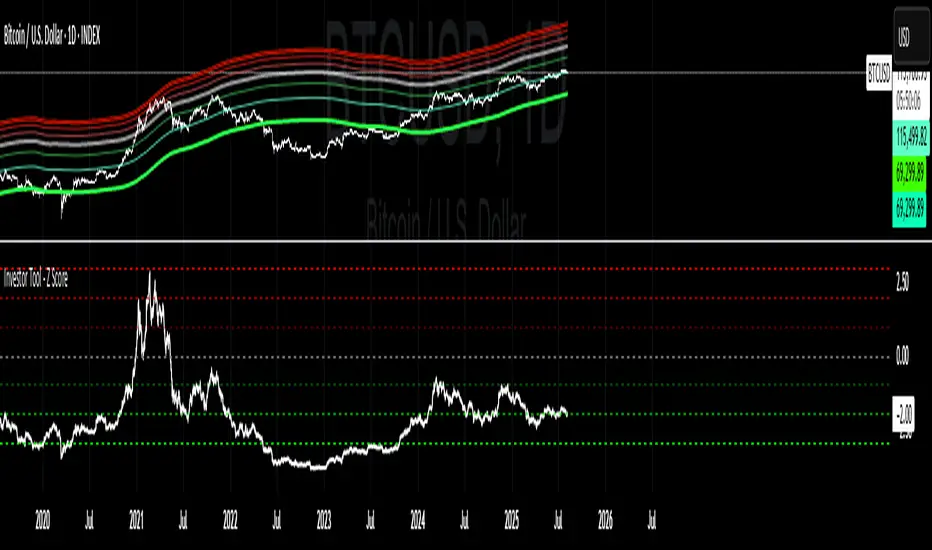
Investor Tool - Z ScoreThe Investor Tool is intended as a tool for long term investors, indicating periods where prices are likely approaching cyclical tops or bottoms. The tool uses two simple moving averages of price as the basis for under/overvalued conditions: the 2-year MA (green) and a 5x multiple of the 2-year MA (red). Price trading below the 2-year MA has historically generated outsized returns, and signalled bear cycle lows. Price trading above the 2-year MA x5 has been historically signalled bull cycle tops and a zone where investors de-risk. Just like the Glassnode one, but here on TV and with StDev bands Now with Z-SCORE calculation: The Z-Score is calculated to be -3 Z at the bottom bands and 3 Z at the top bands mean = (upper_sma + bottom_sma) / 2 bands_range = upper_sma - bottom_sma stdDev = bands_range != 0 ? bands_range / 6 : 0 zScore = stdDev != 0 ? (close - mean) / stdDev : 0 Created for TRW Pine Script® Indikatorvon Commandoum16
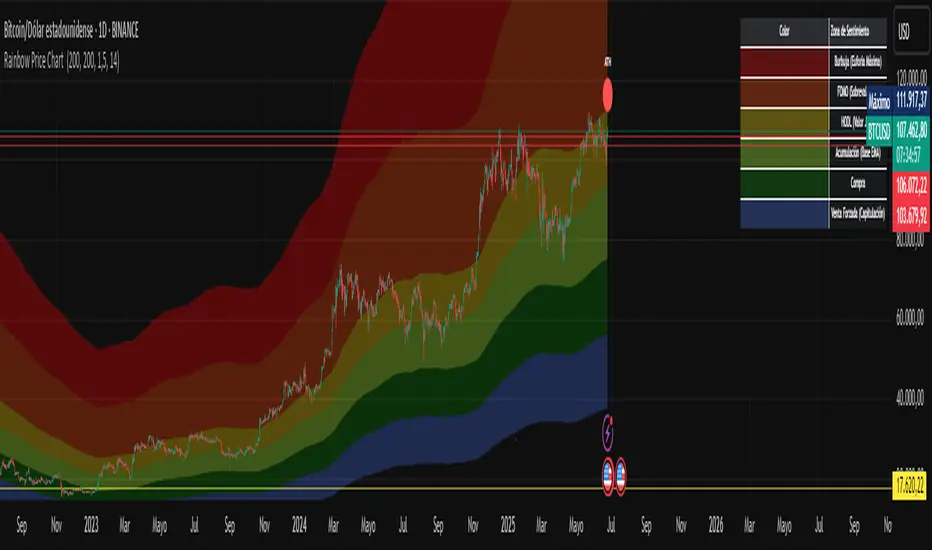
Rainbow Price Chart This indicator is a technical and on-chain analysis tool for Bitcoin, designed to help investors better understand the different phases of the market cycle and underlying sentiment. It directly overlays on the price chart (overlay=true). Indicator Name: "Rainbow Price Chart & V/T Ratio Signals" General Purpose: It combines two popular methodologies for visualizing Bitcoin's value and sentiment: the classic "Rainbow Price Chart" and signals derived from the "Value per Transaction Ratio" (V/T Ratio) based on blockchain data. It is ideal for long-term investors looking for strategic entry/exit points. Main Components: Rainbow Price Chart: Concept: Divides Bitcoin's price range into different market "sentiment zones" (e.g., "Bubble Zone," "FOMO Zone," "HODL Zone," "Accumulation Zone," "Buy Zone," "Fire Sale Zone") using colored bands. These bands are calculated as ascending and descending multiples of a base Exponential Moving Average (EMA), configurable by default to 200 periods. Visualization: The zones are represented with transparent color fills on the price chart. A detailed legend in the top right corner of the chart explains the meaning of each color and sentiment zone. Important Note: This type of chart is designed to be viewed and analyzed correctly on a logarithmic price scale. The indicator includes a visual reminder to activate this scale. Value per Transaction (V/T) Ratio Signals: Concept: Measures the average value per transaction on the Bitcoin blockchain by dividing the total transacted volume in USD by the number of transactions. This ratio is smoothed with an Exponential Moving Average (by default, 7 periods) and is framed within a dynamic Linear Regression Channel (LRC) based on standard deviation. Signal Generation: Based on the position of the smoothed V/T Ratio within this LRC channel, the indicator generates signals directly on the price chart, such as: "BOTTOM": Low price, V/T Ratio in the lower band of the LRC. "SEMI-LOW" / "SEMI-HIGH": Intermediate phases within the channel. "ATH" (All-Time High): Potentially overvalued price, V/T Ratio in the upper band of the LRC. On-Chain Data: The indicator requests external daily on-chain data for total transacted volume (TVTVR) and number of transactions (NTRAN) from the Bitcoin blockchain. Diagnostic Panes: Includes plots of the raw on-chain data (volume and number of transactions) in a separate pane, which are useful for debugging or verifying the data source. The lines for the V/T Ratio itself and its LRC channel are not plotted by default but can be activated in the code for deeper analysis. Ideal for: Bitcoin investors and "hodlers" who desire a visual tool that combines price-based market cycle context with fundamental signals derived from on-chain activity, to help identify key moments for accumulation or potential distribution. Considerations: Relies on the availability of external on-chain data (QUANDL:BCHAIN) within TradingView. Functions best on a daily timeframe.Pine Script® Indikatorvon DavidGLZCrypto66
Schaff Trend Cycle (STC)The STC (Schaff Trend Cycle) indicator is a momentum oscillator that combines elements of MACD and stochastic indicators to identify market cycles and potential trend reversals. Key features of the STC indicator: Oscillates between 0 and 100, similar to a stochastic oscillator Values above 75 generally indicate overbought conditions Values below 25 generally indicate oversold conditions Signal line crossovers (above 75 or below 25) can suggest potential entry/exit points Faster and more responsive than traditional MACD Designed to filter out market noise and identify cyclical trends Traders typically use the STC indicator to: Identify potential trend reversals Confirm existing trends Generate buy/sell signals when combined with other technical indicators Filter out false signals in choppy market conditions This STC implementation includes multiple smoothing options that act as filters: None: Raw STC values without additional smoothing, which provides the most responsive but potentially noisier signals. EMA Smoothing: Applies a 3-period Exponential Moving Average to reduce noise while maintaining reasonable responsiveness (default). Sigmoid Smoothing: Transforms the STC values using a sigmoid (S-curve) function, creating more gradual transitions between signals and potentially reducing whipsaw trades. Digital (Schmitt Trigger) Smoothing: Creates a binary output (0 or 100) with built-in hysteresis to prevent rapid switching. The STC indicator uses dynamic color coding to visually represent momentum: Green: When the STC value is above its 5-period EMA, indicating positive momentum Red: When the STC value is below its 5-period EMA, indicating negative momentum The neutral zone (25-75) is highlighted with a light gray fill to clearly distinguish between normal and extreme readings. Alerts: Bullish Signal Alert: The STC has been falling It bottoms below the 25 level It begins to rise again This pattern helps confirm potential uptrend starts with higher reliability. Bearish Signal Alert: The STC has been rising It peaks above the 75 level It begins to decline This pattern helps identify potential downtrend starts.Pine Script® Indikatorvon mihakralj101
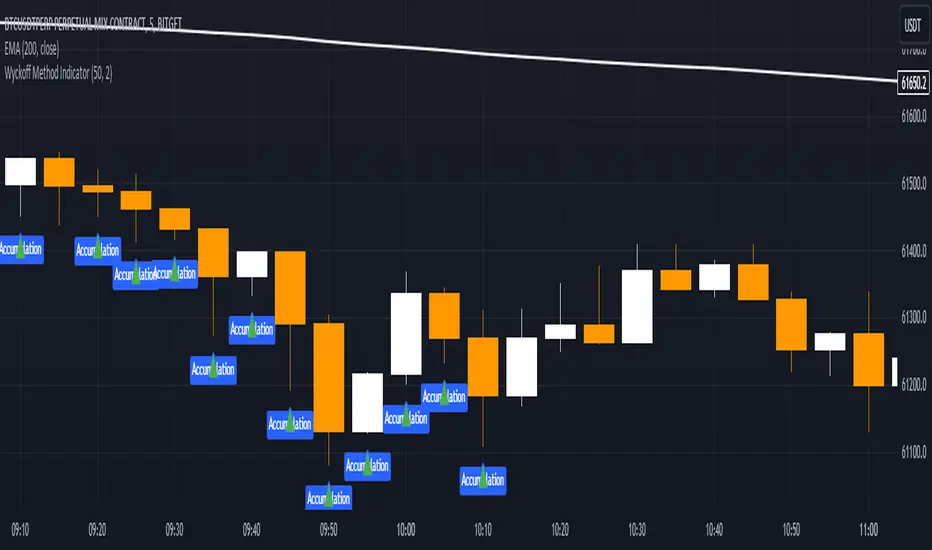
Wyckoff Method IndicatorThe Wyckoff Method Market Cycle Indicator is a powerful tool designed to help traders identify the current market phase based on the principles of the Wyckoff Method. This indicator analyzes price action and volume patterns to determine whether the market is in an accumulation, markup, distribution, or markdown phase. The Wyckoff Method, developed by Richard D. Wyckoff, is a time-tested approach to understanding market dynamics and identifying potential trading opportunities. By studying the interaction between price and volume, the Wyckoff Method aims to provide insight into the actions of market participants and the potential direction of the market. This indicator automatically detects the key market phases as defined by the Wyckoff Method: Accumulation: This phase occurs when large institutional investors are quietly accumulating positions, often leading to a period of consolidation with low volatility and decreasing volume. Markup: Following the accumulation phase, the markup phase is characterized by a breakout above the accumulation range, accompanied by increasing volume. This indicates a potential bullish trend. Distribution: After a significant price advance, the distribution phase emerges. It is marked by high volatility and increasing volume as large investors begin to distribute their holdings to the public. Markdown: The markdown phase follows the distribution phase and is characterized by a breakdown below the distribution range, accompanied by increasing volume. This suggests a potential bearish trend. The indicator plots the detected market phases on the chart using the following signals: Green triangle pointing upwards: Accumulation phase Blue triangle pointing downwards: Markup phase Red triangle pointing downwards: Distribution phase Orange triangle pointing upwards: Markdown phase By utilizing this indicator, traders can gain valuable insights into the underlying market structure and make more informed trading decisions. However, it is important to note that the Wyckoff Method Market Cycle Indicator should be used in conjunction with other technical analysis tools and risk management strategies. The indicator provides two input parameters: Lookback Period: The number of bars used to calculate the volatility and determine the market phases. The default value is 50. Volume Condition Multiple: The multiple used to compare the current volume with the volume of the lookback period. The default value is 2. Traders can adjust these parameters to suit their specific trading style and the characteristics of the asset being analyzed. Please note that this indicator is intended for educational and informational purposes only. It does not constitute financial advice. Always conduct your own analysis and exercise proper risk management when trading. Happy trading!Pine Script® Indikatorvon TrendActionHawk299
Financial Astrology Venus DeclinationVenus crossing zero declination towards the south direction until the minima is reached seems to produce that the price change slows down and calms the volatility. This also coincides with few small corrections in ETHUSD, looks that Venus moving from South to North declination path produce much more strong trends. This Venus declination pattern needs more research in others markets, I have analysed BTCUSD and was not able to see any clear cycle with Venus declination, will be great to get the participation from more financial astrologers that could research this declination cycle in other markets and share feedback with us. Note: The Venus declination indicator is based on an ephemeris array that covers years 2010 to 2030, prior or after this years the declination is not available, this daily ephemeris are based on UTC time so in order to align properly with the price bars times you should set UTC as your chart reference timezone.Pine Script® Indikatorvon citlacom1164
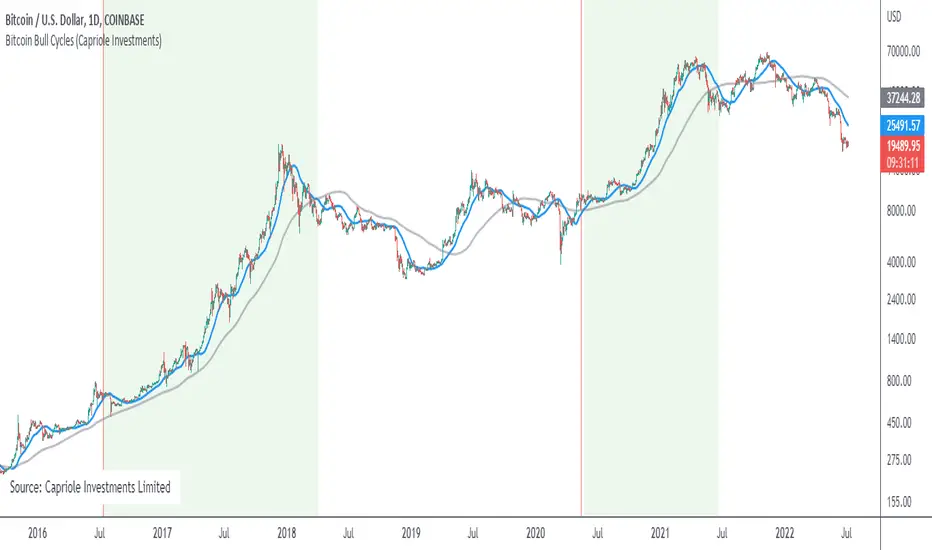
Bitcoin Bull CyclesA simple indicator that identifies the primary upswing of Bitcoin following each Halving, the "Bull Cycle". A "Bull Cycle" is identified as the first period of positive momentum after each Halving date, defined as the 50 Daily Moving Average (DMA) being above the 200 DMA. Pine Script® Indikatorvon capriole_charlesAktualisiert 33959
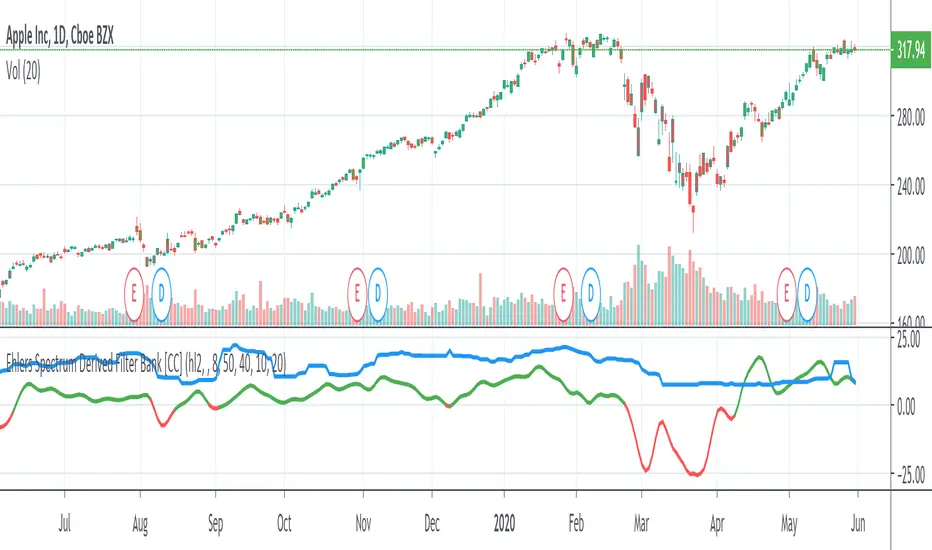
Ehlers Spectrum Derived Filter Bank [CC]The Spectrum Derived Filter Bank was created by John Ehlers (Stocks & Commodities V. 26:3 (16-22)) and this is technically two indicators in one. This will let you know the current cycle period which is in blue and the other indicator will let you know if you should buy the stock or not. Buy when it is green and sell when it is red. Let me know if you would like me to publish other scripts or if you want something custom done! Note: I'm republishing this because the original script couldn't be found in searches so this will fix that.Pine Script® Indikatorvon cheatcountryAktualisiert 44114
TOP & BOTTOM Cycle [aamonkey]Works best on BTC and only on the daily timeframe! This is a TOP / BOTTOM indicator for big market cycles. These tops and bottoms are based on the difference between the 200MA on the daily and the price.Pine Script® Indikatorvon aamonkeyAktualisiert 1111960
BTC - NMI: Network Metabolism IndexBTC - Network Metabolism Index (NMI) | RM Concept & Background The Network Metabolism Index (NMI) is a fundamental valuation model that treats Bitcoin as a biological organism. While price is the "face" of the asset, the NMI measures its "internal organs"—specifically its physical security and its social circulation. Computational Logic: The Assembly Line To arrive at the final NMI score, the indicator follows a rigorous four-step deterministic process: • Step 1: Metric Selection: We ingest three high-fidelity data streams from Glassnode. Difficulty (Security), Active Addresses (Utility), and Market Cap (Price). • Step 2: Fair Value Proxy (FVP) Computation: We calculate the network's intrinsic strength using a modified Metcalfe Law. We square the Active Addresses to account for network effect growth and multiply it by the Square Root of Difficulty to weight the value by physical security. • Step 3: Log-Ratio Normalization: Because the FVP represents astronomical values of physical and social work, we calculate the Natural Logarithm of the Market Cap divided by the FVP . This places the data into a usable, though deep-negative, "dimensionless" territory. • Step 4: Denoising & Banding: We apply a 14-day Least Squares Moving Average (LSMA) to the result to strip away daily volatility. Finally, we wrap the curve in 1.5 Standard Deviation bands to identify statistical "Fever" (Overvalued) and "Starvation" (Undervalued) zones. The Y-Axis is measured in Nats (Natural Logarithmic Units). Important: Users should treat these units as dimensionless . Because the fundamental proxies for security and utility are so mathematically dominant, the resulting values reside in a negative logarithmic territory . The absolute numerical value is secondary to the morphology of the curve and its position relative to the dynamic Sigma bands. Core Features / User Inputs • LSMA Denoising: A linear regression filter to reveal structural trends. • Dynamic Sigma Bands: 365-day rolling bands that adapt to Bitcoin's maturing market cycle. • Regime Audit Dashboard: Real-time classification of the network state. How to Read The Chart • Metabolic Starvation (Blue Zone): Security and utility are significantly higher than price reflects. A generational value opportunity. • Metabolic Fever (Red Zone): Price is over-extended relative to the network's biological reality. • Neutral (Grey): Price and health are in a sustainable balance. Data Feed Disclaimer This indicator requires access to the Glassnode professional data feeds (Difficulty, Active Addresses, and Market Cap). Users without a valid subscription to these alternative data sets will not see the oscillator render. This script is intended for macro analysis; it is not financial advice. General Disclaimer This indicator is a mathematical model based on historical on-chain data. It is intended for educational purposes and macro analysis. On-chain metrics are lagging by nature and should be used in conjunction with a robust risk management strategy. This is not financial advice. Tags Rob Maths, Rob_Maths, robmaths, Bitcoin, OnChain, Glassnode, FundamentalAnalysis, MetcalfeLaw, Quant, Macro, Difficulty, ActiveAddresses, ValuationModel, NetworkMetabolismPine Script® Indikatorvon Rob_Maths9
Crypto MACD SignalsUnlocking Enhanced Market Insights: A Next-Generation MACD Indicator for Cryptocurrency Trading Introduction: Beyond Traditional MACD In the vast landscape of technical analysis tools, the Moving Average Convergence Divergence (MACD) stands as one of the most ubiquitous and trusted momentum indicators. However, its classic formulation often leaves traders sifting through frequent crossovers, struggling to distinguish high-probability signals from market noise, especially in the volatile cryptocurrency markets. This script represents a significant evolution of the classic MACD, transforming it from a standalone oscillator into a comprehensive, multi-layered signal detection system. Its core originality lies not in reinventing the MACD calculation, but in augmenting it with proprietary filtering mechanisms, quantitative signal scoring, and visual prioritization to enhance decision clarity and timing. Core Functionality: What It Does and How It Achieves It This indicator, titled "Crypto MACD Signals," is a dedicated, non-overlay oscillator built for clarity and actionability. It performs three primary functions simultaneously: Enhanced MACD Visualization: It plots the traditional MACD line, Signal line, and Histogram with a refined color scheme. The histogram is dynamically colored (blue for bullish, orange for bearish) but introduces a key innovation: the identification of "Huge" or "Anomalous" Bars. A bar is highlighted in bright white when its size exceeds twice the 20-bar Simple Moving Average of the absolute histogram values. This instantly draws attention to moments of exceptional momentum surge or capitulation, which often precede significant trend accelerations or reversals. Context-Aware Signal Generation: Instead of marking every MACD line crossover, the script applies a crucial logical filter. It only plots a "BUY" signal (green upward triangle) when a bullish crossover occurs while the histogram is below the zero line. Conversely, a "SELL" signal (red downward triangle) is plotted only when a bearish crossover occurs while the histogram is above the zero line. This filter ensures signals are generated in the context of a potential trend reversal from an oversold or overbought state, rather than during the middle of a strong trend, dramatically increasing the signal's statistical edge. This aligns with a classic "Oscillator Reversal from Extremes" methodology within trend-following systems. Real-Time Performance Dashboard: A fixed table in the top-right corner serves as a live statistical dashboard. It tracks and displays the total count of: Generated Buy Signals Generated Sell Signals Total "Huge" Histogram Bars (both bullish and bearish) This provides traders with an at-a-glance understanding of recent market activity—whether it has been signal-rich or quiet, and the frequency of high-momentum events—aiding in assessing the current market regime (e.g., trending vs. consolidating). Implementation and Practical Usage The indicator is designed for tactical swing trading and momentum-based intraday positioning in crypto assets. Its primary use case is for identifying "Pullback Entries within a Trend" and "Early Trend Reversal Confirmations." For Trend-Following: A trader in an established uptrend would wait for a pullback that drives the MACD histogram negative. A subsequent bullish crossover that triggers a "BUY" signal, especially if accompanied by a "Huge" bullish histogram bar, offers a high-confidence entry point to re-join the trend. For Counter-Trend/Reversal Scenarios (Scalping): The script is highly effective for a specific scalping technique: "Fading Extreme Momentum Exhaustion." A cluster of "Huge" bearish bars followed by a diminishing histogram and a bullish crossover signal can indicate selling exhaustion, presenting a short-term long scalp opportunity. The inverse applies for short scalps. The labels ("🔥") and arrows provide clear visual cues for these setups directly on the chart. Workflow: Traders are advised to first observe the statistical table to gauge recent activity. Then, they should look for convergence between a filtered arrow signal (BUY/SELL) and the appearance of a "Huge" bar or a cluster of them. This multi-factor confirmation is the cornerstone of the strategy. Underlying Philosophy and Calculation Logic The script's intelligence is built on a layered philosophy of "Momentum Quantification and Contextual Validation." Dynamic Thresholding for Anomalies: The "Huge Bar" detection does not use a fixed threshold. By comparing the current histogram value to a recent average of absolute momentum (ta.sma(math.abs(hist_line), 20)), it creates an adaptive, market-responsive benchmark. A bar that is 200% larger than recent average momentum is statistically anomalous, suggesting institutional-sized order flow or a major shift in sentiment. This is a direct application of statistical volatility band principles to momentum, not price. Signal Filtering for Phase Alignment: The conditional logic for plotting arrows (bullish_cross and hist_line < 0) ensures the MACD crossover signal is aligned with the correct momentum phase of the market cycle. A buy signal is only valid if momentum (histogram) is coming from a "recharging" or bearish area (below zero), not when it's already extended above zero. This prevents buying at a peak and selling at a trough, which is a common pitfall of the raw indicator. This embodies the trading axiom: "Trade the turn, not the continuation." Quantitative Self-Awareness: The integrated counter and dashboard represent a meta-analysis layer. It allows the tool to provide feedback on its own performance density. A market generating many signals might be choppy and range-bound, while a market with few signals but several "Huge Bars" might be in a strong, steady trend. This helps the trader select the appropriate strategy (trend riding vs. reversal scalping) for the current environment. In essence, this script synthesizes several respected trading concepts: the core trend/momentum logic of MACD, the anomaly detection common to volatility-based indicators like Keltner Channels, and the signal-verification philosophy of multi-indicator systems—all packaged into a single, coherent, and visually intuitive tool specifically tuned for the unique amplitude and speed of cryptocurrency markets. Pine Script® Indikatorvon neeson19874
Bullish Divergence SMI Base & Trigger with ATR FilterDescription: A bullish divergence indicator combining the Stochastic Momentum Index (SMI) and Average True Range (ATR) to pinpoint high-probability entries: 1. Base Arrow (Orange ▲): • Marks every SMI %K / %D bullish crossover where %K < –70 (deep oversold)—the first half of the divergence setup. • Each new qualifying crossover replaces the previous base, continuously “arming” the divergence signal. • Configurable SMI lookbacks, oversold threshold, and a base timeout (default 100 days) to clear stale bases. 2. Trigger Arrow (Green ▲): • Completes the bullish divergence: fires on the next SMI bullish crossover where %K > –60 and price has dropped below the base arrow’s close by at least N × ATR (default 1 × 14-day ATR). • A dashed green line links the base and trigger to visually confirm the divergence. • Resets after triggering, ready for a new divergence cycle. Inputs: • SMI %K Length, EMA Smoothing, %D Length • Oversold Base Level (–70), Trigger Level (–60) • ATR Length (14), ATR Multiplier (1.0) • Base Timeout (100 days) Ideal for any market, this study highlights genuine bullish divergences—oversold momentum crossovers that coincide with significant price reactions—before entering long trades.Pine Script® Indikatorvon suresh78960
IlluminateThe Illuminate script predicts the potential range of Bitcoin's top and bottom prices based on a logarithmic regression model, referencing Bitcoin's historical price trends and halvings. This script is designed to provide valuable insights into Bitcoin's price dynamics and long-term trends using principles derived from the "Bitcoin Law." Key Features Power Law Trend Lines Primary Trend: Projects the general growth trajectory of Bitcoin prices over time based on a logarithmic power law. Resistance Line: Identifies a potential upper limit of Bitcoin prices during market peaks. Includes an offset trendline for an additional buffer zone. Support Line: Represents a possible bottom for Bitcoin prices during market downturns. Offset trendlines highlight potential zones of price fluctuation near the support line. Fill Zones: Between resistance and offset: Semi-transparent Red. Between support and offset: Semi-transparent Green/Blue. Bitcoin Halving Events Automatically marks significant Bitcoin halving dates with yellow vertical lines and labeled annotations. Current and future halvings (approximate) are included. Trending Phase Indication A dynamic visual color fill highlights different phases of Bitcoin's price evolution based on a 4-year cycle. Colors: Red, Green, Blue, Orange (indicating each phase). "Trending Phase" label provides insight into the current phase. Interactive Inputs Show/Hide Resistance: Toggle resistance trend lines. Show/Hide Support: Toggle support trend lines. Show/Hide Halving Dates: Toggle visibility of halving annotations. Customizable Parameters Fine-tune parameters (A and n) for the main trend line to match your analysis needs. How to Use Overlay Analysis: Add this script to your TradingView chart for direct overlay on Bitcoin's price data. Interpret the Zones: Use the resistance and support lines as potential upper and lower bounds for price movements. Analyze fill zones for areas of likely price oscillation. Halving Significance: Observe price behavior before and after halving dates, which historically influence market trends. Long-Term Perspective: The model is optimized for long-term projections, making it suitable for strategic, rather than short-term, trading decisions. Disclaimer: This indicator is for educational purposes only and should not be used as investment advice. Always do your own research and consult with a financial advisor before making trading decisions.Pine Script® Indikatorvon truongdweAktualisiert 153
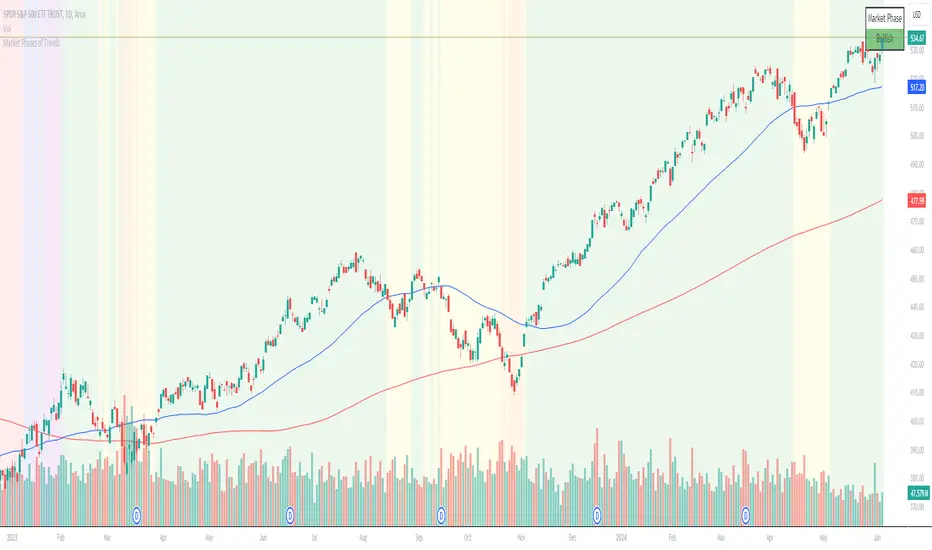
Chuck Dukas Market Phases of Trends (based on 2 Moving Averages)This script is based on the article “Defining The Bull And The Bear” by Chuck Duckas, published in Stocks & Commodities V. 25:13 (14-22); (S&C Bonus Issue, 2007). The article “Defining The Bull And The Bear” discusses the concepts of “bullish” and “bearish” in relation to the price behavior of financial instruments. Chuck Dukas explains the importance of analyzing price trends and provides a framework for categorizing price activity into six phases. These phases, including recovery, accumulation, bullish, warning, distribution, and bearish, help to assess the quality of the price structure and guide decision-making in trading. Moving averages are used as tools for determining the context preceding the current price action, and the slope of a moving average is seen as an indicator of trend and price phase analysis. The six phases of trends // Definitions of Market Phases recovery_phase = src > ma050 and src < ma200 and ma050 < ma200 // color: blue accumulation_phase = src > ma050 and src > ma200 and ma050 < ma200 // color: purple bullish_phase = src > ma050 and src > ma200 and ma050 > ma200 // color: green warning_phase = src < ma050 and src > ma200 and ma050 > ma200 // color: yellow distribution_phase = src < ma050 and src < ma200 and ma050 > ma200 // color: orange bearish_phase = src < ma050 and src < ma200 and ma050 < ma200 // color red Recovery Phase : This phase marks the beginning of a new trend after a period of consolidation or downtrend. It is characterized by the gradual increase in prices as the market starts to recover from previous losses. Accumulation Phase : In this phase, the market continues to build a base as prices stabilize before making a significant move. It is a period of consolidation where buying and selling are balanced. Bullish Phase : The bullish phase indicates a strong upward trend in prices with higher highs and higher lows. It is a period of optimism and positive sentiment in the market. Warning Phase : This phase occurs when the bullish trend starts to show signs of weakness or exhaustion. It serves as a cautionary signal to traders and investors that a potential reversal or correction may be imminent. Distribution Phase : The distribution phase is characterized by the market topping out as selling pressure increases. It is a period where supply exceeds demand, leading to a potential shift in trend direction. Bearish Phase : The bearish phase signifies a strong downward trend in prices with lower lows and lower highs. It is a period of pessimism and negative sentiment in the market. These rules of the six phases outline the cyclical nature of market trends and provide traders with a framework for understanding and analyzing price behavior to make informed trading decisions based on the current market phase. 60-period channel The 60-period channel should be applied differently in each phase of the market cycle. Recovery Phase : In this phase, the 60-period channel can help identify the beginning of a potential uptrend as price stabilizes or improves. Traders can look for new highs frequently in the 60-period channel to confirm the trend initiation or continuation. Accumulation Phase : During the accumulation phase, the 60-period channel can highlight that the current price is sufficiently strong to be above recent price and longer-term price. Traders may observe new highs frequently in the 60-period channel as the slope of the 50-period moving average (SMA) trends upwards while the 200-period moving average (SMA) slope is losing its downward slope. Bullish Phase : In the bullish phase, the 60-period channel showing a series of higher highs is crucial for confirming the uptrend. Additionally, traders should observe an upward-sloping 50-period SMA above an upward-sloping 200-period SMA for further validation of the bullish phase. Warning Phase : When in the warning phase, the 60-period channel can provide insights into whether the current price is weaker than recent prices. Traders should pay attention to the relationship between the price close, the 50-period SMA, and the 200-period SMA to gauge the strength of the phase. Distribution Phase : In the distribution phase, traders should look for new lows frequently in the 60-period channel, hinting at a weakening trend. It is crucial to observe that the 50-period SMA is still above the 200-period SMA in this phase. Bearish Phase : Lastly, in the bearish phase, the 60-period channel reflecting a series of lower lows confirms the downtrend. Traders should also note that the price close is below both the 50-period SMA and the 200-period SMA, with the relationship of the 50-period SMA being less than the 200-period SMA. By carefully analyzing the 60-period channel in each phase, traders can better understand market trends and make informed decisions regarding their investments.Pine Script® Indikatorvon bvdbeld21147